Buy European, But How? What the Public Consultation on the Revision of the Public Procurement Directives Tells Us About European Preferences and Third-Country Economic Operators
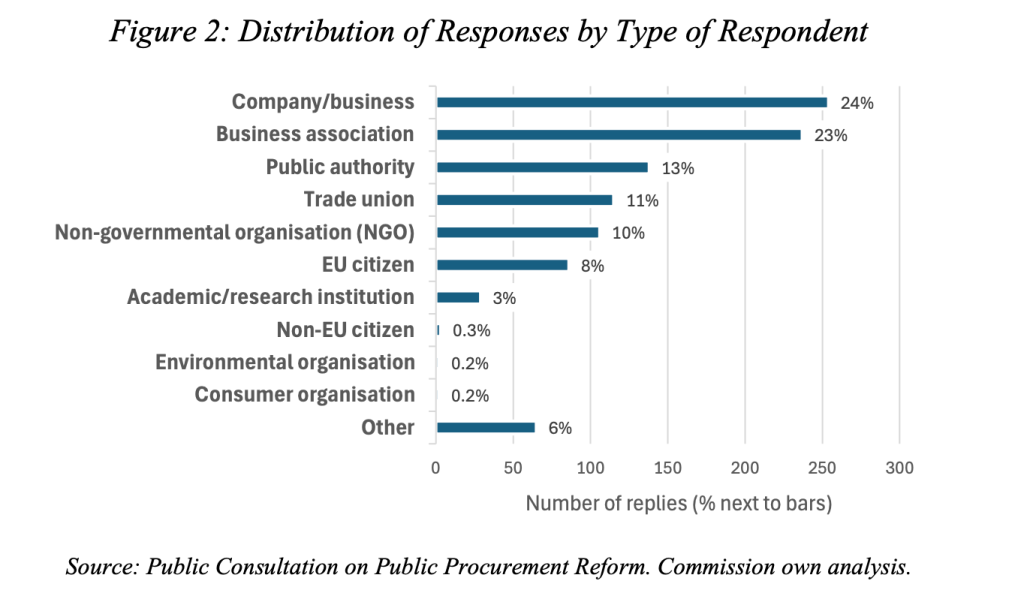
On 27 March 2026, the Commission published the Factual Summary Report on the Public Consultation on the Revision of the Public Procurement Directives. Of the 1,037 responses received, the overwhelming majority came from business-related stakeholders — companies and business associations together make up 47% of respondents, with public authorities at 13%, trade unions at 11% and NGOs at 10%. Academics contributed a mere 3%. This is not a representative sample of EU stakeholder opinion on public procurement reform, and should not be treated as one. But it does reveal the direction in which the political wind is blowing — and for anyone interested in the external dimension of EU public procurement law, that direction is unmistakable.
On a side-note, it seems Pedro Telles always beats me and addresses these things first, so definitely read his thoughts here.
The protectionist consensus
All respondent groups except non-EU participants expressed support above 80% for prioritising European goods and services in public procurement. The three concrete mechanisms tested in the consultation all received strong endorsement: expanding the role of non-price criteria — including social, environmental, resilience, innovation, security and “Made in Europe” considerations — at 92%; defining “Made in Europe” criteria for bidder selection, such as requiring a European business location or setting value-added conditions, at 85%; and excluding bidders from countries that lack secured access to EU public procurement markets through international legal commitments, at 68%.
The last of these options is particularly interesting. The fact that this was the least supported of the three options suggests that stakeholders prefer indirect preference mechanisms — non-price criteria, value-added thresholds — over outright exclusion. The preference is for tilting the playing field rather than closing the gate.
But who will bear the cost?
What makes these results particularly notable is the candour with which respondents acknowledged the expected costs — 63% anticipated higher prices, 62% expected retaliation by third countries, 51% foresaw increased administrative costs for public buyers, and 46% for EU bidders themselves. But the distribution of these costs deserves closer scrutiny. Higher prices are absorbed by contracting authorities’ budgets, not by the private sector’s bottom line, and administrative complexity lands on public buyers who must verify origin and carbon content rather than on the companies supplying the products. Even the retaliation risk is diffuse and speculative, whereas the benefits — protected market share and reduced third-country competition — accrue directly and immediately to EU industry. In other words, the most enthusiastic constituency in these consultations, private sector respondents, is advocating for a regime whose costs will be borne predominantly by public purchasers, which makes this not so much an uninformed preference as a perfectly rational one — for those on the right side of the ledger.
The disconnect between priorities and mechanisms
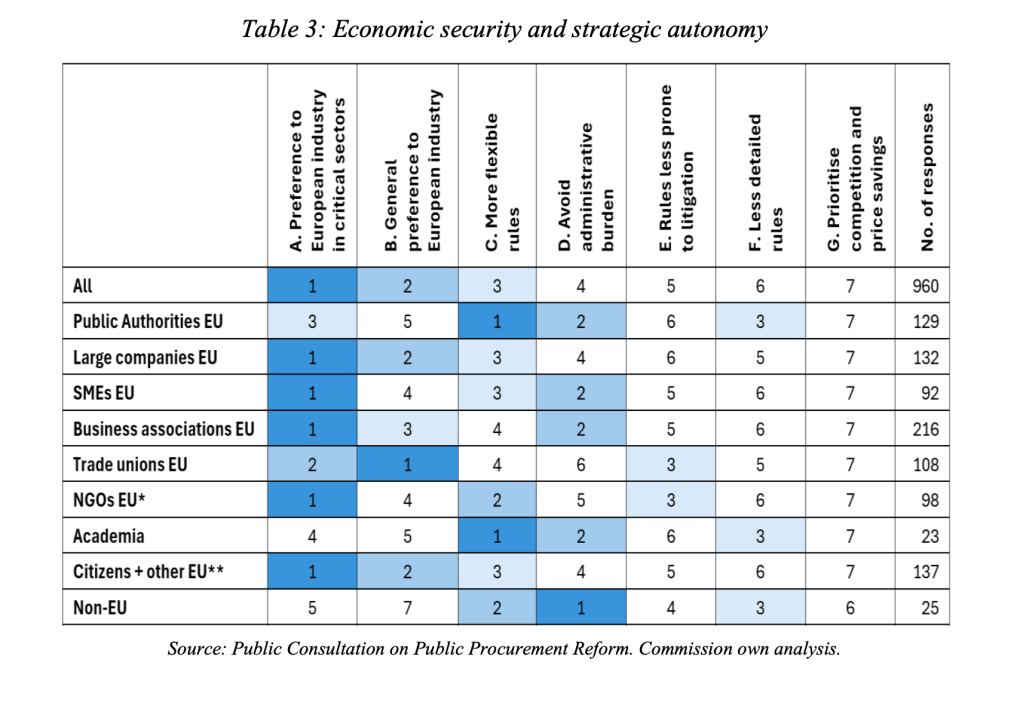
A tension runs through the consultation data that deserves attention. In the priority-ranking exercise (Table 3), respondents were asked to rank objectives related to economic security and strategic autonomy. Most groups ranked “preference to European industry in critical sectors” first, with “general preference to European industry” second. This suggests a preference for sector-specific rather than horizontal protectionism.
But the detailed “Made in Europe” questions on page 6 of the report present all three preference mechanisms — non-price criteria, bidder selection criteria, and exclusion of non-covered operators — in universal terms, without any sectoral limitation. The consultation design did not test whether respondents would support these mechanisms only in critical sectors. It presented universal tools and asked whether respondents supported them — and they overwhelmingly did.
What the consultation does not address
The term “third-country economic operator” does not appear in the consultation report. Nor does the report engage with the CJEU’s conclusions in the Kolin (C-652/22) and Qingdao (C-266/22) judgments, which confirmed that the conditions under which third-country economic operators may participate in EU public procurement procedures fall within the EU’s exclusive competence under the common commercial policy.
The CJEU has established that only the EU may legislate on third-country economic operator access, which means that Member States cannot act, and contracting authorities across twenty-seven legal systems must decide case by case, in individual procurement procedures, whether to admit or exclude and how to treat third-country economic operators — without a comprehensive legal framework. The consultation’s focus on “Buy European” preferences, while ignoring the legal architecture that should underpin any preference regime, risks producing legislation that layers preference mechanisms onto selected sectors while leaving the general third-country participation regime in the same state of fragmentation that the Kolin and Qingdao judgments produced.
The Commission’s programming documents and the draft Industrial Accelerator Act confirm that this selective approach is deliberate. Von der Leyen’s political guidelines announced preferences “for certain strategic sectors.” The Single Market Strategy refined this to “certain technologies and strategic sectors.” Neither document contemplates a comprehensive framework for third-country economic operator participation. The consultation results, with their overwhelming support for universal preference mechanisms, may push the Commission toward broader protectionism — but there is no indication that they will push it toward the comprehensive legislation that the constitutional situation requires.
My position
I have recently submitted a paper that argues this situation constitutes a constitutional deficit — exclusive competence without comprehensive legislation. The EU has confirmed, through the CJEU, that it alone may legislate on third-country economic operator access, and it has then failed to do so comprehensively, leaving contracting authorities with inadequate, lacuna-filled rules established by the Court. The result is fragmentation — the precise outcome that the conferral of exclusive competence was designed to prevent.
The consultation’s respondent base is skewed toward economic operators with a commercial interest in protectionism, and the results should be read with that in mind. But on one fundamental point, I agree with the direction the consultation signals: the new directives need to legislate this issue comprehensively rather than selectively or sector by sector. The EU claimed this competence and now needs to exercise it with a coherent framework that addresses admission, participation conditions and remedies in a manner consistent with the constitutional principles that justify the conferral of exclusive competence in the first place.
The alternative — continued selectivity, continued fragmentation, continued reliance on the problematic provisional regime the CJEU established — is constitutionally untenable. Whether the forthcoming legislative proposal will recognise this remains to be seen.

 UPRAVNO PRAVO