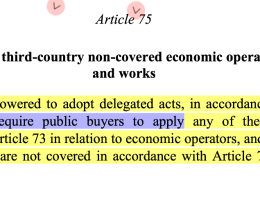
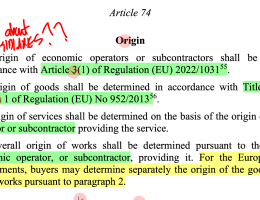
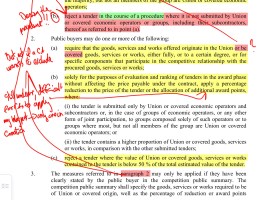
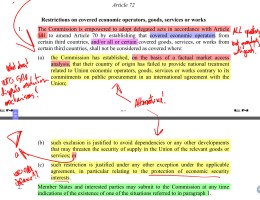
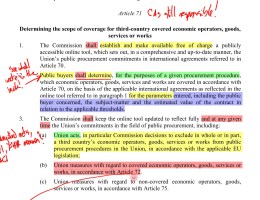
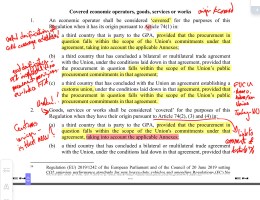
Book is out – ”Third Country Economic Operators in EU Procurement Law Conditions for Market Participation”
This will be the shortest post I ever wrote: the book is out – go buy it! Here it the link, the first chapter is open access!
The previous post on this blog reported a dataset of 185 Croatian public procurement procedures published between December 2025 and May 2026, in which contracting authorities had stated their intention to exclude third-country economic operators in accordance with the post-Kolin amendment to the Regulation on Procurement Documentation and Tender in Public Procurement Procedures. The combined…
It has become unconfirmed ”common knowledge” that Croatian contracting authorities are not excluding third-country economic operators, and that it’s still business as usual. This seemed especially to be the case in late September 2025, when I submitted the manuscript for my upcoming book to Edward Elgar. A lot of time has passed since then, and…
A brief disclaimer before I get into this: what follows is based on two news reports – one from XYZ’s Poland Unpacked newsletter and one from MILMAG – covering the launch of Poland’s “Local Content: For the Benefit of Poland” initiative on 9 April 2026. If the statements attributed to Prime Minister Donald Tusk and…
Read more Local Content Just Won’t Die – And Poland’s Government Is Making It Worse
A new corruption case has recently been uncovered in Croatia, this time in the Croatian Ski Association. The former director was charged with syphoning over 30 million EUR over many years. If you’re interested in the story, here is a good summary; machine translation will work well. Since I seem to have a one-track mind,…
Read more Sports Federations and Public Procurement: A Love Story That Never Happened
On 27 March 2026, the Commission published the Factual Summary Report on the Public Consultation on the Revision of the Public Procurement Directives. Of the 1,037 responses received, the overwhelming majority came from business-related stakeholders — companies and business associations together make up 47% of respondents, with public authorities at 13%, trade unions at 11%…
The University of Zagreb Faculty of Law and the Croatian Employers’ Association are pleased to announce that registration is now open for the international conference “Geopolitics and Public Procurement”, to be held on 1 July 2026 at the Faculty of Law, University of Zagreb (Trg Republike Hrvatske 3, Lecture Room III). Attendance is free. Register…
Read more Registration Open: “Geopolitics and Public Procurement” Conference — Zagreb, 1 July 2026
The European Commission published its proposal for the Industrial Accelerator Act (IAA) on 4 March 2026. The proposal establishes a framework of measures for the acceleration of industrial capacity and decarbonisation in strategic sectors. Pedro Telles has already published a very useful reflection on the proposal on his blog (https://www.telles.eu/some-preliminary-impressions-on-the-industrial-accelerator-act-proposal/), which I recommend reading alongside…
New paper out! I spent weeks scraping 17,695 public procurement notices from Croatia’s electronic procurement platform (EOJN) and going through 6,409 draft contracts to answer a question nobody has empirically tackled in Croatia before: how often do contracting authorities actually choose private arbitration over regular courts for resolving public procurement contract disputes? The short answer…
Anti-Coercion Instrument is in the news again, this time as a potential tool to counter the new tariffs threat from the US. It was not used the last time, but all bets are off this time around. This is all, at least from a policy and normative perspective, very unexpected, as the ACI was envisaged…
Read more Anti-Coercion Instrument – it’s not a trade bazooka, it’s a trade trebuchet