Sports Federations and Public Procurement: A Love Story That Never Happened
A new corruption case has recently been uncovered in Croatia, this time in the Croatian Ski Association. The former director was charged with syphoning over 30 million EUR over many years. If you’re interested in the story, here is a good summary; machine translation will work well.
Since I seem to have a one-track mind, this led me to one of the things in Croatian procurement I never quite understood – why don’t Croatian sports federations/associations conduct public procurement procedures? While far from perfect, public procurement is designed to constrain the purchasing (e.g. money-spending) discretion of public bodies, and maybe it would have helped in preventing outcomes like this one.
The legal basis for being considered a ‘contracting authority’ is, according to Article 6 of the Croatian PPA, the same as Article 2 of Directive 2014/24/EU. With regard to sports federations, the most consequential subcategory of contracting authorities is ‘bodies governed by public law’.
Article 2(1)(4) of Directive 2014/24/EU defines bodies governed by public law as bodies that cumulatively fulfil the following criteria:
- They are established for the specific purpose of meeting needs in the general interest, not having an industrial or commercial character;
- They have legal personality; and
- They are financed, for the most part, by the State, regional or local authorities, or by other bodies governed by public law; or are subject to management supervision by those authorities or bodies; or have an administrative, managerial or supervisory board, more than half of whose members are appointed by the State, regional or local authorities, or by other bodies governed by public law.
So, pretty much straightforward. But does it apply to sports federations? As an example, I’ll take one such public body that seems to be continuing where the Ski Federation left off, the Croatian Judo Federation (CJF). More on these developments here.
CJF has legal personality of course. It is established to meet needs of general interest and does not have an industrial or commercial character under Articles 4 and 11 of its Statute, available here.
So, the only thing left to establish is – is the CJF predominantly financed by other contracting authorities? The best way to do so of course is to take a look at its most recent financial report, available here.
According to the report, the CJF’s annual budget is approximately 3 million EUR. Out of the 3 million, about 1.5 million EUR comes from donations from the budget (state budget but mostly from local and regional – cities and counties – budgets). Almost a million EUR comes from the Croatian Olympic Committee – a contracting authority in its own right.
So – the financing is overwhelmingly public – by other contracting authorities. So why doesn’t the CJF conduct public procurement procedures?
This is of course not only a question for CJF, but for all sports associations where public funding eclipses own earnings or private sponsorships. If you search the new Croatian E-tenders daily, only four sports associations have conducted public procurement procedures:
- Croatian Volleyball Federation
- Zagreb Sports Association
- Croatian Gymnastics Association and
- Croatian Karate Association.
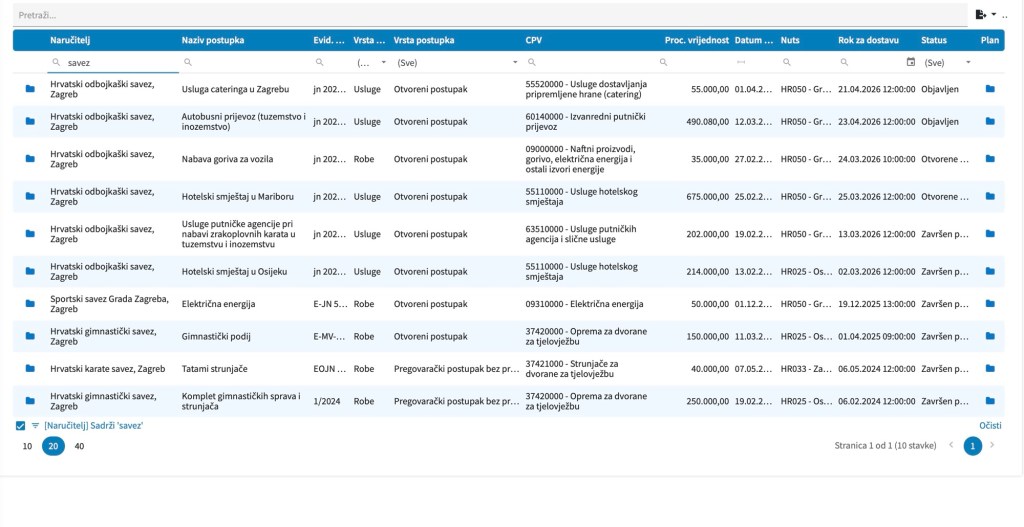
In the old E-tenders daily (in the last 10 years) there were only a few associations conducting public procurement procedures
- Sports Association of Požega
- Croatian Academic Sports Association
- Croatian School Sports Association
- Croatian Kayaking Association
- University Sports Association of Zagreb
- Croatian Mountaineering Association
- Croatian Karate Association
- Football Association of Osijek-Baranja County)
Cumulatively they conducted 60 public procurement procedures. So – what do these Associations know that the Ski Association, CJF, and many, many others – do not?
If a given sports association is getting over 50% of its budget from other contracting authorities – it must conduct public procurement procedures. Otherwise, millions of EUR are being spent unchecked, as financial audits of sports associations’ budgets have proved not to be an effective illegality screening tool (the ski association had a financial audit each year).
Furthermore, if nothing gets resolved, a minority of sports associations that understand their position as contracting authorities is at a disadvantage over the vast majority of those that resist the application of the PPA. This of course further widens the possibility of corruption.
But this is not only a sports association problem. There are many other kinds of public bodies in Croatia not conducting public procurement procedures even though they should (most public pharmacies, some publicly owned LLCs to name a few). Some of them have been involved in heavily publicized corruption scandals in the past (not the pharmacies of course). Maybe the time has finally come to legislate on this issue?


