From Freshwater Fish Burgers to Big Infrastructure Projects: An Empirical Update on Third-Country Economic Operator Exclusions in Croatia 18 Months after the Kolin Judgment
It has become unconfirmed ”common knowledge” that Croatian contracting authorities are not excluding third-country economic operators, and that it’s still business as usual. This seemed especially to be the case in late September 2025, when I submitted the manuscript for my upcoming book to Edward Elgar. A lot of time has passed since then, and some concrete data would be nice. Since there is nothing officially available, I decided to do a data-scrape and see the real situation on the ground. I scraped all available contract notices from 1 December 2025 until 16 May 2026. There is no significant academic reason why this time interval, but it did make sense because it begins more than a year after the Kolin judgement was published, but also around six month after the Ministry of Economy amended the Regulation on Procurement Documentation and Tender in Public Procurement Procedures (Official Gazette 92/2025), which introduced the conclusions from the Kolin and the Qingdao judgments to the widest possible audience. After June 2025 the argument that this is all new and contracting authorities are not familiar with the possibility to exclude and/or implement differential treatment of third-country economic operators is not convincing anymore. Therefore, starting the data-scrape before 1 December 2025 might have produced less realistic results.
The research was done like this; every contract notice listing on the new Croatian Tenders Electronic Daily (Elektronički oglasnik javne nabave – EOJN) has a section called ”upute za ponuditelje.md” (tenderer instructions). If a contracting authority decided to reference third-country economic operators in any way, this section had a subchapter named ” Odredbe vezane uz pristup postupku za treće zemlje” (Provisions related to access of third countries). Claude Opus 4.7. was used to write a Python script that would go through EOJN each month withing the designated time period, check all contracting notices for this subchapter, and if the subchapter existed – convert it into a PDF that was downloaded to my SSD (Claude was also used to visualize the graphs included in this blogpost). Also, a CSV file was compiled for every month with references to every contracting notice checked with a joined EOJN link, and a reference if the contracting notice contains the relevant section. After the scrape was complete, I manually checked each of the 189 links that contained a reference to third countries to see if this reference means they are allowed to participle, or if they are excluded. In four references contracting authorities allowed participation, so they were excluded from the research. Then I created an Excel table where I manually entered the following data for all of the remaining 185 contracting notices with third country exclusions: month of publication; contracting authority name, type and location; public procurements type (goods, services or works); CPV code; procurement object description and estimated value. The final column was named ”Oddities” to note unusual third country references that will be addressed further down.
I plan to use this dataset in upcoming research, and I also plan to update it with new data each month as it becomes available. I’m aware this blogpost could have easily been a paper, but I decided against it in favor of wider and faster dissemination, and also Pedro Telles told be this would be better, and for some reason I value his opinion.
The data I got is really interesting and in some aspects unexpected. This is the analysis that was heavily informed by the conclusions I made in my upcoming book, mostly to see how do those conclusions stack up with the Croatian reality in the months following manuscript submission.
Background
In my book, I described the Croatian approach to the implementation of the Kolin and Qingdao judgments as one of effective non-implementation. At the time of manuscript submission (late September 2025) contracting authorities had almost completely ignored the substantial discretionary power afforded to them by the CJEU; to the best of my knowledge there was only a single Croatian public procurement procedure in which a contracting authority had decided to exclude third-country economic operators, and not a single instance of score adjustments or differential treatment of any kind. The conclusion drawn there – that ”Croatia wants nothing to change” – was supported by both the practical realities on the ground and by the approach of Croatian institutions to favor participation.
The present analysis revisits that claim with the benefit of a dataset. All 8,929 public procurement procedures published in Croatia between 1 December 2025 and 16 May 2026 have been reviewed; 185 of them – 2.07 % – contained provisions excluding third-country economic operators. The combined estimated value of those 185 procedures is just over €1.04 billion sans VAT. Six months after the amended Regulation entered into force, the practice that was so rare it ”captured media headlines” has turned into something else.
The findings below also lend empirical support to several of the criticisms levelled at the Kolin and Qingdao framework – in particular, those concerning the level of discretion afforded to contracting authorities and the practical consequences of the lack of clarity left behind by the Court.
The Data
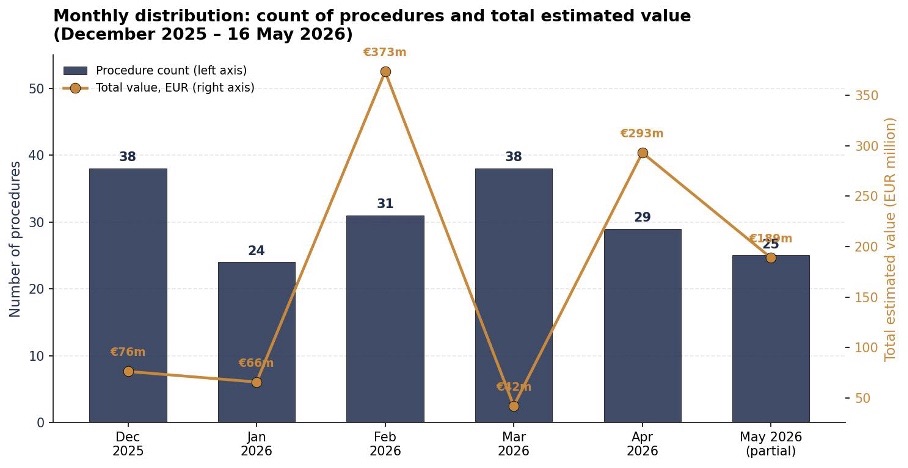
Two observations follow from the monthly distribution. First, the count of procedures has remained broadly stable across the six months. Second, the value distribution is uneven: February 2026 (€373.4 million) and April 2026 (€293.0 million) together account for two-thirds of total value, and this concentration is driven by no more than four or five infrastructure contracts in those two months. The 185 procedures display a count distribution that differs sharply from the value distribution, and both are needed to understand the practice.
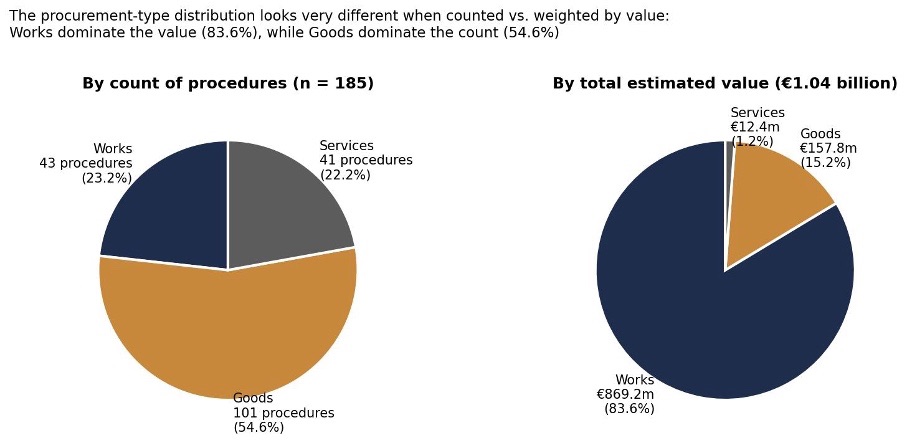
Procurements of goods account for 101 of the 185 procedures (54.6 %), but only €157.8 million of the €1.04 billion in estimated value (15.2 %). Works are the inverse – only 43 procedures (23.2 %) but €869.2 million in value (83.6 %). The median works procedure in the dataset is valued at €1.63 million; the median goods procedure at €98,000. Services are residual: 41 procedures, €12.4 million in total value, and a median of €95,000.
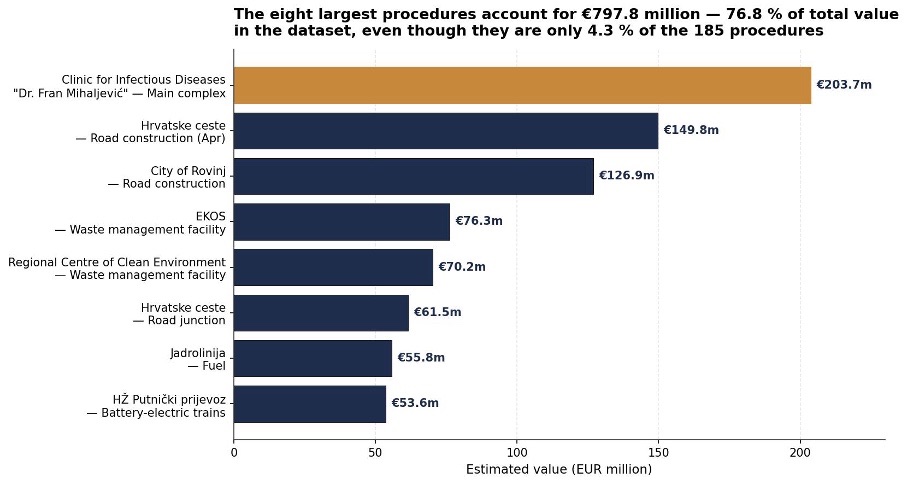
Eight procedures exceed €50 million in estimated value. Their combined value of €797.8 million represents 76.8 % of the total value of all 185 procedures in the dataset, even though they constitute only 4.3 % of the procedures by count. Expanded to the twenty largest, that figure rises to 93.4% – the long tail of small procurements contributes barely 7% of the total value.
Three of the eight are road construction tenders (two by Hrvatske ceste, one by the City of Rovinj, totalling €338.2 million between them). Two are waste management facility construction tenders, almost certainly co-financed by EU structural funds, awarded by EKOS and the Regional Centre of Clean Environment (€146.5 million combined). One is a hospital complex construction tender (Clinic for Infectious Diseases ”Dr. Fran Mihaljević”, €203.7 million – the single largest contract in the dataset). One is the procurement of battery-electric multiple-unit trains by HŽ Putnički prijevoz (€53.6 million). The last is the supply of fuel to Jadrolinija, the state ferry operator (€55.8 million).
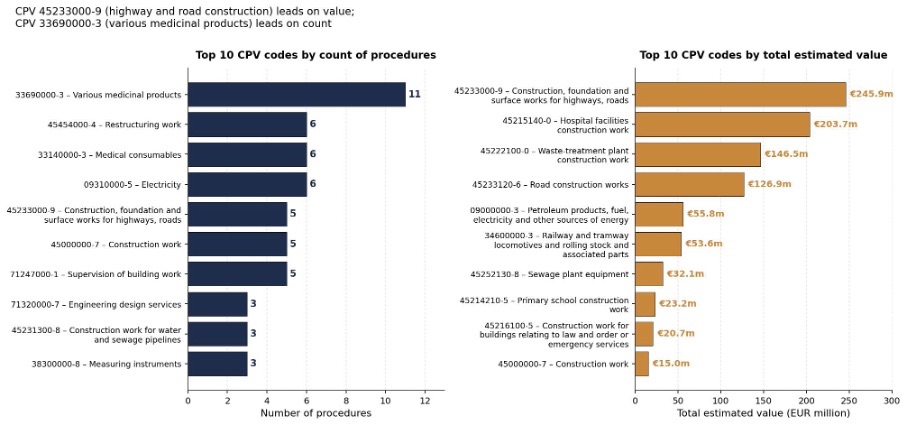
At the level of individual CPV codes, the count distribution is led by a single medical-goods code, while the value distribution is led by an almost unbroken sequence of construction-works codes.
On the count side, CPV 33690000-3 (Various medicinal products) is the single most common code, appearing in 11 procedures with a combined value of only €2.7 million. It is followed by a three-way cluster of CPV 45454000-4 (Restructuring work), CPV 33140000-3 (Medical consumables), and CPV 09310000-5 (Electricity) – each appearing in six procedures, with combined values of €5.6 million, €0.55 million, and €2.7 million respectively. Three further codes appear in five procedures each: CPV 45233000-9 (Construction, foundation and surface works for highways, roads), CPV 45000000-7 (Construction work, general), and CPV 71247000-1 (Supervision of building work).
On the value side, by contrast, the same dataset looks completely different. CPV 45233000-9 (Construction, foundation and surface works for highways, roads) leads with €245.9 million across five procedures. CPV 45215140-0 (Hospital facilities construction work) follows with €203.7 million, generated by the single Clinic for Infectious Diseases ”Dr. Fran Mihaljević” tender. CPV 45222100-0 (Waste-treatment plant construction work) accounts for €146.5 million across two procedures (the EKOS and Regional Centre of Clean Environment facilities). CPV 45233120-6 (Road construction works) adds €126.9 million from the City of Rovinj tender alone. The top four CPV codes by value are therefore all sub-classes of CPV 45 (Construction work), and they jointly account for €722.9 million – almost 70 % of total value in the dataset.
Below the construction works, the remaining codes in the top ten by value are revealing of the strategic infrastructure orientation of the practice. CPV 09000000-3 (Petroleum products, fuel, electricity and other sources of energy) ranks fifth at €55.8 million – entirely attributable to the Jadrolinija fuel tender. CPV 34600000-3 (Railway and tramway locomotives and rolling stock and associated parts) ranks sixth at €53.6 million – the single HŽ Putnički prijevoz battery-electric multiple-unit tender. CPV 45252130-8 (Sewage plant equipment), CPV 45214210-5 (Primary school construction work), CPV 45216100-5 (Construction work for buildings relating to law and order or emergency services), and the general CPV 45000000-7 complete the top ten.
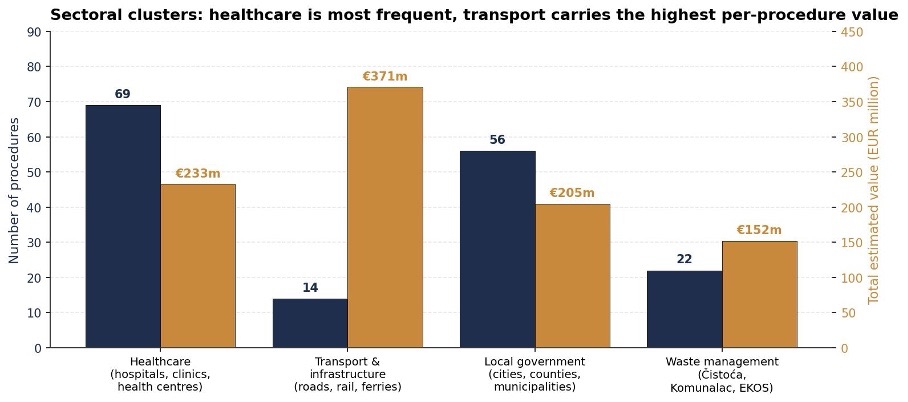
Grouping contracting authorities by mission rather than by CPV refines this:
- Healthcare authorities (hospitals, clinics, health centres, retirement homes) account for 69 of the 185 procedures (37.3 %), with a combined value of €232.7 million. The cluster is dominated in value terms by the single Fran Mihaljević complex (€203.7 million); its routine activity, however, is overwhelmingly small goods purchasing.
- Transport and infrastructure entities (Hrvatske ceste, HŽ Infrastruktura, HŽ Putnički prijevoz, Jadrolinija) generate only 14 procedures but the highest per-procedure value of any cluster (€370.7 million combined, with a mean above €26 million).
- Local government bodies (cities, municipalities, counties) account for 56 procedures totalling €204.8 million; the City of Rovinj road tender (€126.9 million) is the main driver.
- Waste management bodies (Čistoća, Komunalac, EKOS, Regional Centre of Clean Environment) account for 22 procedures totalling €151.8 million, with two co-financed waste-facility projects providing most of the value mass.
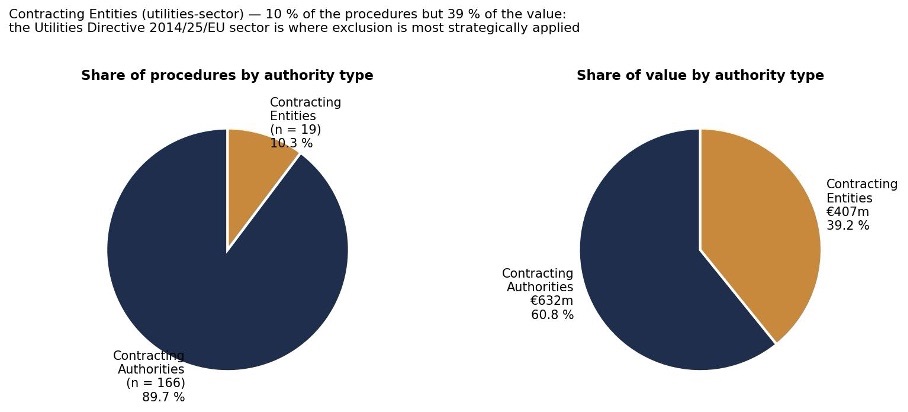
These four clusters cover 87 % of all procedures and 92 % of total value. And there is the prominence of Contracting Entities – the utilities-sector actors regulated under Directive 2014/25/EU. They are only 19 of the 185 procedures (10.3 %), but their combined estimated value is €407.2 million, or 39.2 % of the total.
At the level of individual contracting authorities, the dataset is heavily concentrated. One institution – General Hospital ‘Dr. Josip Benčević’ in Slavonski Brod – accounts for 30 of the 185 procedures, or 16.2 % of the dataset. The combined estimated value of these 30 procedures, however, is only €4.4 million, with a median of €88,000. Twenty-seven of the 30 are goods (haemodialysis consumables, medical gases, protective clothing, foodstuffs, small laboratory equipment); the remaining three are services and none are works.
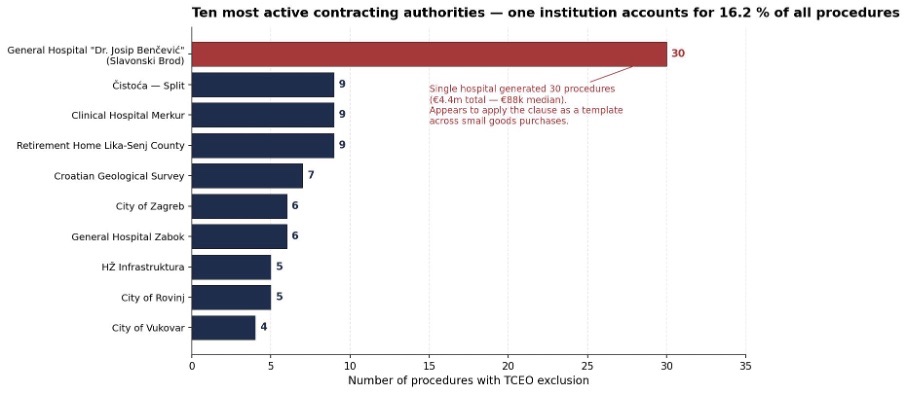
This is almost surely template-driven. Such templatization of the exclusion is in tension with the case-by-case logic the CJEU set out in Kolin, which fvors individualised assessment for each procurement procedure.
Furthermore, Hrvatske ceste is now present in the dataset with four further procedures; the Croatian Geological Survey accounts for 7 procedures; Čistoća Split for 9; Clinical Hospital Merkur for 9; the Retirement Home of Lika-Senj County for 9. In each of these cases the procedures cluster within a narrow band of related procurement subjects, suggesting that the decision to exclude is being taken at the institutional rather than the project level.
Anomalies
Five procedures in the dataset display anomalies that deserve particular attention, because they are empirical evidence of the very ‘lack of clarity’ identified as one of the three principal defects of the Kolin and Qingdao framework in the book.
The five procedures are:
- Hrvatske ceste — bypass construction (December 2025, estimated value €15.0 million). The procurement documentation provides for a ‘score adjustment of 20 %’ applied to third-country economic operators. This is, to my knowledge, the first – and, on the present dataset, regrettably the only – concrete implementation of a score adjustment in Croatia after the Kolin and Qingdao judgments. In substance, the 20 % rate is a meaningful adjustment: it is large enough to be capable of changing tender outcomes in competitions where price plays a significant role and it can be used as a useful lower limit for score adjustments in general.
- Regional Development Agency of Karlovac County – technical design (estimated value below €100,000). The procurement documentation references third-country economic operators in general terms, then proceeds to discuss only the Russia-specific sanctions regime under Regulation 833/2014, confusing the two instruments.
- Primary Health Care Centre of Požega-Slavonia County – cars (estimated value approximately €170,000). The procurement documentation imposes an obligation on bidders to report foreign subsidies received in the previous two years. This appears to be a Foreign Subsidies Regulation-style declaration, despite the procurement falling far below the FSR notification threshold (€250 million for works, €15 million for goods and services). Either the contracting authority is using FSR-style reporting as a de facto third-country screening tool in a procurement that is not within the FSR’s material scope, or there has been a substantial over-implementation of EU law by an authority that has misunderstood the threshold regime.
- Municipality of Draganić – electricity (estimated value approximately €200,000). The same thing as the Karlovac case: the procurement documentation begins with limitations applicable to all third-country economic operators but then continues into a list of Russian-connection screening criteria.
- Clinical Hospital Merkur — medical gases (estimated value €14.5 million). The procurement documentation states that the contracting authority ‘limits access’ to third-country economic operators but does not specify the mechanism by which the limitation is to be enforced. Whether this is a hard exclusion, a score adjustment or something else is left unstated.
Implications
The data presented above is consistent with – and in several respects strengthens – the case made in the book for a better solution to third-country economic operator participation. Two points are worth emphasising.
Discretion
The book argues that the three levels of discretion conferred by Kolin and Qingdao;
- whether to admit,
- whether to apply score adjustments if admission is granted, and
- whether to ‘set out arrangements for treatment intended to reflect the objective difference’ between third-country and covered economic operators
should be reduced to one: the decision whether to admit, with score adjustments becoming mandatory and the third level abolished. The Croatian experience to date supports this proposal in two ways. First, the third level of discretion has not been used: not a single procurement in the dataset, to my reading, contains a substantive provision implementing ‘arrangements for treatment intended to reflect the objective difference’ in any way distinct from outright exclusion. Second, the only attempted score adjustment in the dataset – Hrvatske ceste’s 20 % adjustment on the bypass tender – is itself instructive and should be used as a lower limit for mandatory score adjustments in the Directive revision process.
Transparency
The book’s proposal that contracting authorities should be required to explain their decision to exclude is partially answered by the existing Croatian Regulation, which requires the intention to exclude to be stated ‘clearly and explicitly’ in the procurement documentation. But – as the Benčević hospital pattern demonstrates – a formal requirement to state the exclusion is not the same as a substantive requirement to justify it. Where 30 procedures by a single hospital, covering everything from haemodialysis consumables to protective clothing, contain identical exclusion language, the formal transparency requirement is satisfied while the substantive purpose of transparency – to allow scrutiny of a discretionary policy choice – is not. The proposal that contracting authorities should be required to ‘explain their decision to exclude’ in substance, and not merely to state it, gains additional weight here.
A Very Long Conclusion
Almost a year after the entry into force of the amended Regulation on Procurement Documentation and Tender, the picture of Croatian implementation of Kolin and Qingdao has changed. My initial conclusions – that Croatia favors participation, that contracting authorities retain wide and largely unexercised discretion – remains correct. But the empirical claim that exclusion is, in practice, a virtually unused option must now be revised. What began as a single public procurement procedure in late summer of 2025 is now 185 public procurement procedures (€1.04 billion sans VAT) in only six months. A couple of conclusions:
- strategic exclusions in selected big infrastructure, healthcare construction, and waste-facility tenders;
- institutional standardization by a small number of contracting authorities;
- drafting confusion in a small but non-trivial share of procedures, particularly those that conflate the general Kolin discretion with the mandatory Russia sanctions regime or the FSR notification regime.
The dataset reveals a fourth pattern: exclusion has become largely automatic and templated. For the vast majority of the 185 procedures, the decision to include an exclusion clause does not appear to be a deliberate, case-by-case assessment demanded by the CJEU in the Kolin judgement.
At times the result is plainly nonsensical. The dataset contains, among others, the following procedures in which the practical risk of a third-country economic operator submitting a competitive tender is, on any realistic view, vanishingly small:
- The City of Vukovar’s procurement of freshwater fish burgers (CPV 15220000-6 Frozen fish, fish fillets and other fish meat) at an estimated value of €46,080.
- The City of Knin’s two procedures for stray dog management (CPV 85200000-1 Veterinary services), at €40,000 each..
- Insurance procurements by Istria County (€1.34 million) and the Special Hospital Varaždinske Toplice (€46,000), both under CPV 66510000-8 Insurance services.
- Postal services procurements by Čistoća LLC Split (€1.25 million) and the City of Sveta Nedjelja (€85,000), under CPV 64110000-0 Postal services – a regulated universal-service market within Croatia.
- Multiple small electricity-supply procurements (CPV 09310000-5 Electricity), ranging from €30,000 (Municipality of Draganić) to €1,000,000 (City of Ogulin), and including a €39,150 procurement by Kindergarten ‘Videk’.
- Hotel accommodation services for the Education and Teacher Training Agency (CPV 55110000-4) at €38,938.
- The procurement of cured meats (CPV 15130000-8) and miscellaneous food products (CPV 15800000-6) by the Retirement Home of Lika-Senj County and other authorities, in amounts of €40,000 – €220,850.
The CJEU in Kolin and Qingdao bases its conclusions on the interpretation of Articles 25 of Directive 2014/24/EU and 43 of Directive 2014/25/EU. These Articles refer to ‘works, supplies, services and economic operators’ as four distinct categories. The right to ‘treatment no less favourable’ that those articles reserve for the works, supplies, services and economic operators of GPA signatories and FTA partners is, by negative implication, not available to any of these four categories where they originate in a third country with which the EU has no relevant agreement. The Kolin and Qingdao discretion therefore extends in principle not only to third-country economic operators, but also to third-country supplies (and services) – even when those goods are offered by an EU economic operator.
Yet the same Articles 25 and 43 must be read together with Articles 29 and 34 TFEU. According to Article 29 TFEU, products coming from a third country are to be considered as being in ”free circulation” in a Member State if the import formalities have been complied with and any customs duties or charges of equivalent effect have been levied and not subsequently refunded. The Union Customs Code (Regulation (EU) No 952/2013) ensures that once an importer in a Member State has paid the applicable duties, those goods enter free circulation within the entire Union and benefits from the prohibition on quantitative restrictions and measures of equivalent effect under Article 34 TFEU.
This conclusion has direct implications for a significant share of the dataset. None of the Croatian procurement documents reviewed here engages with this distinction. Contracting authorities appear to operate under the impression that the Kolin discretion is exclusively about the economic operator submitting the tender. They appear to be unaware, first, that Articles 25 and 43 of the directives allow them to exclude not only third-country economic operators but also third-country supplies – and, second, that even if they were to exercise that further discretionary power, it would not reach goods already in free circulation within the Union. The practical consequence is that, for a substantial share of the small Goods procurements in the dataset (medicines, medical consumables, IT equipment, office furniture, laboratory instruments, foodstuffs, fuels, electricity), the exclusion clause is doubly inert: first, because there was never any realistic prospect of a third-country economic operator bidding directly into the Croatian market for these supplies, and second, because the goods themselves – to the extent they entered the Croatian or any other Member State market through the ordinary customs route – are already EU goods and could not lawfully be excluded as third-country goods even if the contracting authority sought to do so.
Read against the size of the Croatian public procurement market as a whole, the practice documented in this blogpost is still a minority phenomenon. I should note at the outset that the analysis covered only public procurement procedures and not simple procurement (jednostavna nabava); the figures that follow are accordingly benchmarked against the public procurement segment of the Croatian market only. According to the Ministry of Economy’s Statistical Report on Public Procurement in the Republic of Croatia for 2024 (the latest report currently available), the total value of public procurement in Croatia in 2024 was €14,340,590,803 sans VAT, of which €12,407,180,457 was concluded through standard public procurement procedures and €1,833,432,908 through ‘simple procurement’ (jednostavna nabava). The relevant figure for tthis post is therefore the €12.41 billion of standard public procurement, not the wider €14.34 billion figure. Annualised, the €1.04 billion in exclusion-clause procedures identified in the six-month dataset corresponds to roughly €2.08 billion, or approximately 16.8 % of the 2024 public procurement market (excluding simple procurement) by value. The remaining 83.2 % – close to €10.3 billion per year – remains formally open to third-country economic operators. Exclusion of third-country economic operators is therefore still an exception rather than a rule.
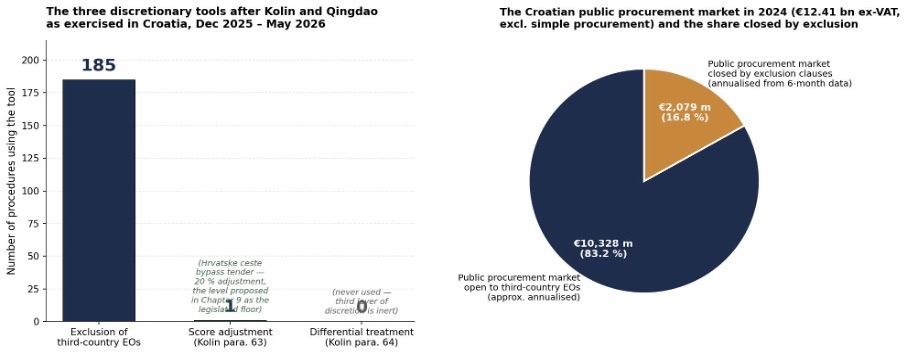
But the more telling finding concerns the differential use of the three discretionary tools the CJEU placed in contracting authorities’ hands. Paragraph 63 of Kolin contemplates two sequential decisions – first, whether to admit a third-country economic operator at all; second, if admission is granted, whether to apply a score adjustment to that operator’s tender. Paragraph 64 then adds a third tool: the possibility for contracting authorities to ‘set out, in the procurement documents, arrangements for treatment intended to reflect the objective difference’ between third-country and covered economic operators. Where Croatian contracting authorities have engaged at all with the post-Kolin rules, they have done so by reaching for the bluntest available instrument – closing the procedure to third-country economic operators entirely – rather than by attempting any of the more nuanced forms of differential treatment the CJEU contemplated. And where they have chosen not to use that instrument, they have not substituted any other form of differential treatment in its place. The third-country economic operators allowed to participate in the remaining 83.2 % of the market by value are competing on terms identical to those of EU and FTA-covered operators. The post-Kolin framework, in its Croatian implementation, has thus produced a binary: either complete exclusion, or no differential treatment at all.
This binary outcome is precisely what I argue should be avoided. My recomendations were as follows:
- contracting authorities should be allowed the discretion to decide whether to allow or exclude third-country economic operators from their public procurement procedures on a case-by-case basis;
- this discretionary decision needs to be clearly stated in the procurement documents, as well as explained by the contracting authority;
- score adjustments for third-country economic operators allowed to participate must be mandatory;
- the range of applicable score adjustments should be legislated;
- the upper limit of score adjustments should be modelled after Article 6(8) of the IPI — up to 50 %, and up to 100 % if the price or cost is the only contract award criterion;
- the lower limit of score adjustments should also be legislated, one that would substantially reduce the final scores of third-country economic operators;
- the discretionary power to decide to implement ‘arrangements for treatment intended to reflect the objective difference between the legal situation’ of third-country economic operators and covered economic operators should be removed;
- third-country economic operators allowed to participate in an EU public procurement procedure should have access to the same remedies and the same appeal grounds as any other economic operator, and they need to be fully protected by EU law as well as national law transposing EU law.
Many elements listed here find new empirical support in the dataset. The third layer of discretion – the most opaque of the three – has not been used at all in six months of Croatian practice, confirming both that it is dispensable and that its retention serves no identifiable purpose. The second layer – score adjustments – has been used exactly once. That is, on its face, a regrettable finding: it is the more nuanced differential-treatment tool the post-Kolin framework was supposed to make available.
The deepest lesson of the Croatian experience between December 2025 and May 2026 is, however, this: contracting authorities cannot be relied upon, in any systematic way, to give effect to the external dimension of EU public procurement law. Their institutional interests are, almost by definition, narrower than those of the European Union. As argued in the book, the EU has an interest in differential treatment of third-country economic operators precisely because reciprocity and the encouragement of new FTAs depend on it; EU economic operators have an interest in not being undercut on their home market by non-GPA bidders that benefit from disciplines the EU does not impose on them; and yet individual contracting authorities have an interest in maximising competition and minimising prices in the procurement procedures they themselves run, regardless of where that competition originates. The discretion the CJEU placed in contracting authorities’ hands is the discretion to subordinate the EU and EU-operator interests to their own. The Croatian data show that, except in a small minority of strategic infrastructure tenders, that is exactly what is happening.
This is not a criticism of Croatian contracting authorities in particular. They are doing what contracting authorities are designed to do: procuring what they need at the best price available within the legal framework. The criticism is of a framework that asks them to do more than that – to act as the operational arm of the EU’s external trade policy – without giving them either the tools, the guidance, or the incentives to do so.
The Croatian experience between December 2025 and May 2026 thus provides early but meaningful empirical confirmation of some of the conclusions reached in the book. The level of discretion currently afforded to contracting authorities is being exercised selectively but inconsistently; the lack of clarity is producing observable drafting defects; the distinction between third-country economic operators and third-country goods in free circulation has been ignored (missed) by contracting authorities; andtwo of the three discretionary tools the CJEU contemplated have been left almost entirely unused. Therefoore, the Croatian approach is now very interesting for the question the book leaves open: whether, in the absence of EU-level legislative action, contracting authorities can develop a coherent practice from the unstable foundations of Kolin and Qingdao.


