2026 Croatia Rule of Law Report from a Procurement Lens: Nothing to See Here, Move Along
The European Commission published its 2026 Rule of Law Report last week, accompanied by individual Country Reports. This post will focus on the Country Report for Croatia.
The recommendations are as follows:
- Continue improving efficiency and case management in commercial and civil cases, as backlogs have decreased but proceeding length remains concerning.
- Strengthen investigations and prosecutions of corruption offences, including high-level cases, and develop specialized technical capacities.
- Improve digitalization to enable effective and systematic verification, as current low control rates stem from inconsistent data structures.
- Broaden safeguards against strategic lawsuits by reviewing defamation laws and encouraging use of procedural dismissal rules, in line with European standards.
- Monitor implementation of amended legislation on fair and transparent allocation of state advertising under the European Media Freedom Act.
Reading the recommendations, you would be forgiven thinking that everything is fine and well in public procurement. No recommendations, which can be construed as no problems significant enough worth highlighting. This would of course be an inaccurate conclusion, a conclusion not even substantiated by the text of the Report itself.
The most relevant public procurement observations can be found in the ”Anti-Corruption Framework” Chapter. And these observations are telling, in what they say and what they omit.
Firstly, Croatia’s procurement has a big perception problem. Corruption and institutional independence perception polls always have to be taken with a grain of salt, as sometimes the attitudes of citizens towards institutions or corruption in general have a hard time reconciling with reality. But the Commission seems to think they are important (they are regularly polled for in the Justice Scoreboard Reports), so therefore you would expect that worrisome results would be among the more important things a Member State would fix.
The Croatian public procurement appeal body (DKOM) has seen a year-on-year 10% bump in its perceived level of independence (from 27% in 2025 to 37% in 2026), which is commendable. But when compared with other Member States, this still shows a worrisome level of confidence in the ability of DKOM to issue impartial decisions.
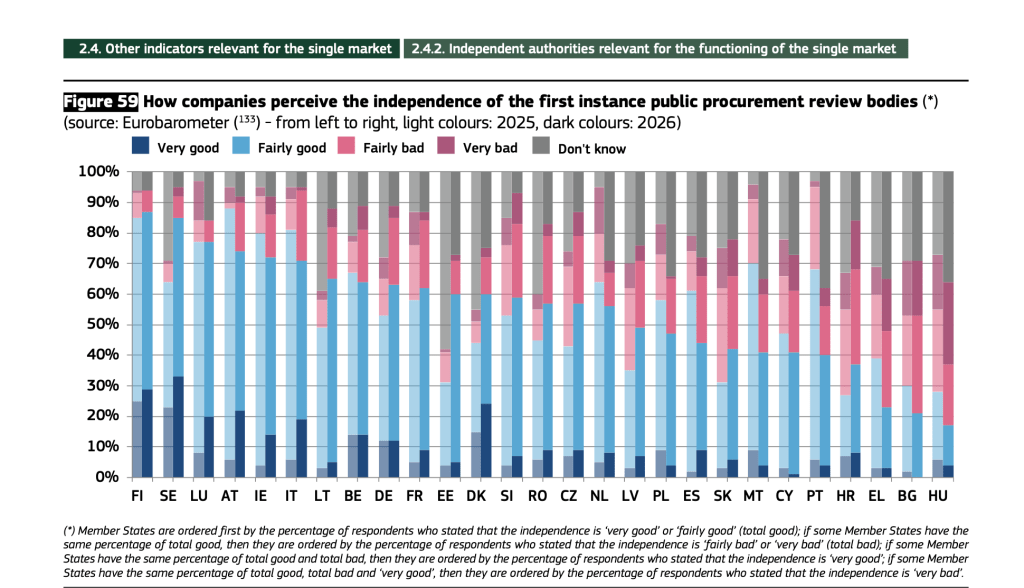
This is very important from the remedies perspective, as this low level of confidence in DKOM’s independence will surely have a deterring effect in the use of remedies to an extent. This wasn’t helped by an unusual long time DKOM was forced to work severely understaffed, as the Government and the Parliament decided to delay the appointment of new members for months, causing significant delays in processing of appeals and forcing the wider public to realise how political pressure can be detrimental to DKOM’s functioning.
In the same vein, the Report just mentions in passing that ”the high level of administrative fees for companies to initiate reviews before DKOM were reported to be the main reason for the low number of reviewed contracts”. And this sentence comes after lauding the recent amendments to the Public Procurement Act, stating that it introduces ” measures to enhance transparency*, efficiency and digitalisation, carrying the potential to reduce corruption risks and conflicts of interest at all stages of the procurement procedure”. Difficult to imagine if the same act has no provisions reducing the appeal fees, which means that the share of public procurement procedures reviewed by DKOM will remain at the paltry 3.5% reported in 2025.
Furthermore, new legislation (or the amendments of thereof) should bring about stability and predictability – especially in a field as complex and prone to changes as public procurement. Therefore it is difficult to justify such expansive amendments (over 80 Articles) a couple months before EU public procurement rules will see the biggest change in decades – the draft Public Procurement Regulation will be released on 9 September.
Taking a bird’s-eye view of these issues: lack of confidence in DKOM’s independence, a significant delay in the appointment of DKOM members, deliberate omitting of reducing appeal fees in the latest PPA Amendments, and the instability and legal unpredictability these PPA Amendments will bring spaced so close to a monumental EU procurement legislative overhaul – shows that they all pull in the same direction – making it more difficult to use remedies in public procurement procedures in Croatia.
It seems to me the Report on the Rule of Law should have addressed this.
*The drafting of the Amendments could have been much more transparent, as there was no publication of the members of the working group – one of the unfortunate Croatian procurement legislative traditions.


