Why Only Construction Exclusions Work: More on the Croatian Third-Country Economic Operator Exclusions Dataset
The previous post on this blog reported a dataset of 185 Croatian public procurement procedures published between December 2025 and May 2026, in which contracting authorities had stated their intention to exclude third-country economic operators in accordance with the post-Kolin amendment to the Regulation on Procurement Documentation and Tender in Public Procurement Procedures. The combined estimated value of those procedures stood at €1.04 billion, distributed across 69 contracting authorities and a range of subject matters that extended from freshwater fish burgers and stray dog management at one end to multi-hundred-million-euro road and railway projects at the other. This follow-up post does not revise the headline of that dataset. It continues the analysis and the analysis suggests that the only category of exclusions in the entire dataset where the exclusion clause has any practical effect is construction works, and that the remaining 142 procedures include the exclusion clause to tenders in which third-country economic operator participation was already commercially or legally unlikely.
The 185 procedures in the dataset divide neatly between construction works on the one hand, and goods and services on the other:
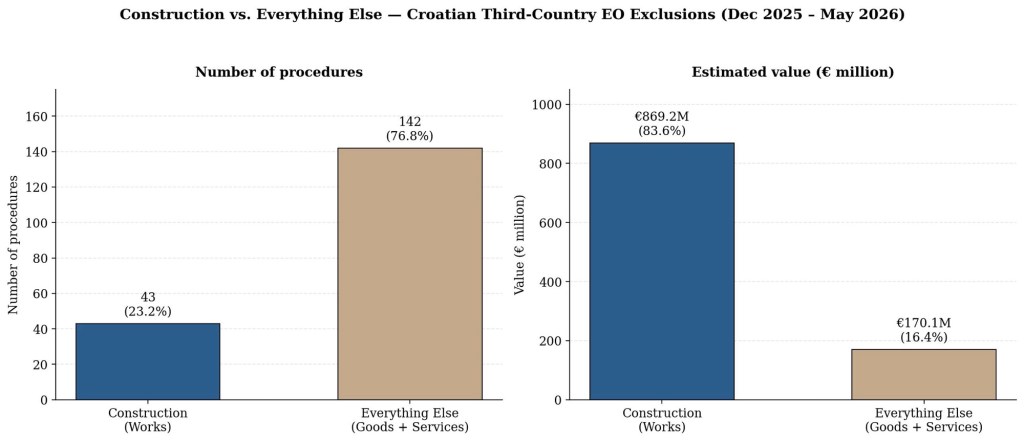
Construction works account for 43 of the 185 procedures, or 23.2% of the count, but €869.2 million, which is 83.6% of the total value of the dataset. Goods and services combined account for the remaining 142 procedures, or 76.8% of the count, with a combined value of €170.1 million, or 16.4% of the total.
The most important reason why the non-construction portion of the dataset is practically ineffective concerns a misunderstanding Croatain contracting authorities seem to be operating under. Article 25 of Directive 2014/24/EU and Article 43 of Directive 2014/25/EU, which the CJEU interprets in the Kolin and Qingdao judgments respectively, place “works, supplies, services and economic operators” on the same level, thus separating economic operators from the works, supplies, and services they provide. Goods and services are therefore listed as separate categories, distinct from economic operators, and each of them can in principle be subject to differential treatment in its own right. The discretionary power conferred on contracting authorities by Kolin and Qingdao to exclude third-country economic operators is, strictly speaking, a power to exclude operators, and the parallel possibility of excluding third-country goods and services is a separate matter that the Croatian Regulation amendment does not mention at all.
Croatian contracting authorities appear to assume that, by excluding third-country economic operators, they are also excluding third-country goods, and that the two exclusions are bound together in a single act. They are not. The exclusion clause as drafted reaches only the operator submitting the tender, and it has no effect whatsoever on the origin of the goods that the operator proposes to supply. An EU economic operator tendering goods that were originally manufactured in a third country is not affected by the exclusion clause, because the clause does not reach the goods through the operator.
The matter becomes still clearer with Article 29 of TFEU in mind. Products coming from a third country are considered to be in free circulation in a Member State if the import formalities have been complied with and any customs duties or charges having equivalent effect which are payable have been levied in that Member State. Goods which have already been imported into the EU by an EU economic operator, and which have cleared the customs of any Member State, become EUgoods, and any subsequent attempt by a contracting authority to exclude them on the basis of their original third-country origin would risk a violation of Article 34 TFEU on quantitative restrictions between Member States. A Croatian wholesaler tendering Chinese-manufactured IT equipment that has already cleared customs in any Member State is an EU economic operator tendering Union goods, and neither the operator nor the goods can be exclded. The same applies to an EU subsidiary tendering medical devices manufactured outside the EU and imported through an EU port, and to virtually every supplier of branded equipment in the goods procurements in the dataset.
There is one situation in which the analysis differs. If the contracting authority is on notice that the economic operator intends to import the goods only after the tender is won, the goods will not yet be in free circulation within the EU at the moment of the tender, and the contracting authority may exclude the tender on the basis that the goods themselves have not entered the customs territory of the EU. This situation, however, does not appear to be reflected in any of the goods procurements in the Croatian dataset, all of which concern routine supplies that the bidder will deliver from existing stock or from established import channels.
The 41 services procurements in the dataset, with a combined estimated value of €12.4 million and a median of approximately €82,000, are dominated by services whose subject matter is by its nature local. They include mosquito control in Vukovar, stray dog management in Knin, IT maintenance for a psychiatric hospital on the island of Ugljan, school catering, construction supervision in small Croatian towns, hazardous waste collection in Varaždin, and accommodation services for the Education and Teacher Training Agency. The combination of small contract values, language-dependent service provision, physical proximity to the place of performance, and the regulatory specificity of the relevant Croatian sectoral law renders third-country participation in these procurements very unlikely.
Why construction exclusions work
Construction occupies an entirely different position within the dataset and within the broader Croatian public procurement market. Third-country economic operators have repeatedly participated in Croatian public procurement procedures for construction works over the past two decades. The Pelješac Bridge, built between 2018 and 2022 by China Road and Bridge Corporation, is the most well-known example. The Kolin case itself was, of course, based on a Turkish tender in a Croatian public procurement procedure. This month (May 2026) the Indian contractor Afcons Infrastructure (all the other bidders were also from India and form Turkey) was selected for the €677 million Dugo Selo–Novska upgrade, described as Croatia’s largest single railway contract ever.
The 43 construction procurements in the dataset are concentrated in those sub-sectors in which third-country participation has, historically, been most likely: road and railway works, major hospital construction, and the long tail of smaller municipal building reconstructions. For these procedures the exclusion clause has a genuine prospect of preventing a third-country bid that would have realistically been submitted and possibly won the tender.
Furthermore, the original blogpost reported that the dataset had been based on 8,929 Croatian public procurement contract notices published between December 2025 and May 2026, which represents the full set of formal public procurement procedures published in Croatia during the near six-month window. The 185 procedures with exclusion clauses therefore represent approximately 2.07% of all procurements published in that period.
The Statistical Report on Public Procurement in the Republic of Croatia for 2024 provides a useful basis for extrapolation. In 2024 Croatian contracting authorities concluded 5,007 contracts for construction works, 20,616 contracts for goods, and 8,983 contracts for services, for a combined total of 34,606 contracts; works therefore accounted for 14.47% of all Croatian public procurement contracts concluded in 2024 by count, and 59.35% of their value. Applying this share to the 8,929 procurements in the dataset yields an estimated 1,200 construction procurements in the dataset overall. The 43 construction procurements with exclusion clauses therefore represent approximately 3.3% of all construction procurements published during the data-scrape window, which is materially higher than the 2.07% overall rate of exclusion across all procurement categories. Even within the category in which exclusion has practical effect, the rate is modest, but it is meaningfully larger compared to the dataset as a whole.
The implications are important in two ways. Thiis confirms that Croatian contracting authorities active in the construction sector are at least beginning to make use of the Kolin discretion in the category where it can actually do something. Also, the great majority of Croatian construction procurements published during the six-month window, approximately 1,200 of them on this extrapolation, continued to be conducted on the standard basis under which third-country economic operators were entitled to participate on equal terms with their EU counterparts.
Conclusion
The misunderstanding about the possible exclusion of third country economic operators and goods identified above calls for considerably more attention than it has thus far received from stakeholders on Croatian but also probably on the EU level. The Croatian Regulation amendment, although it has the considerable merit of having brought the substance of Kolin and Qingdao to the attention of contracting authorities through a binding general act, makes no mention of the possibility of excluding third-country goods. Legislating that possibility, even if it is already arguably available under Kolin and Qingdao, would have raised the awareness of contracting authorities to the existence and the limits of such exclusion, and maybe would have produced practice more coherent and sensible than the one the dataset reveals.
All of this of course is a good argument for a complete rewriting on the rules of third-country economic operator participation in EU public procurement procedures. The most important aspects for this blogpost (there are others, of course, addressed in my book) are that the level of contracting authority discretion conferred by Kolin and Qingdao should be reduced from three layers to one, that score adjustments should be made mandatory rather than optional once a third-country economic operator is admitted to participate, and that third-country economic operators allowed to participate should retain full access to national public procurement remedies.
The Croatian post-Kolin practice is considerably less substantial than it first appears. Of the 185 procurements identified, 43 – concentrated in construction works – are the only ones in which the exclusion clause has any genuine prospect of altering the participation of third-country economic operators in Croatian public procurement. The exclusions in remaining 142 procedures, predominantly small-value goods and services contracts in which the underlying market is either dominated by EU economic operators tendering goods that have already entered free circulation within the internal market, or by purely local Croatian and EU service providers, are practically ineffective. Approximately 1,200 Croatian construction procurements published during the same six-month window were conducted on the standard basis, with third-country economic operators entitled to participate on equal terms. This is untenable, and it is not the goal that the external dimension of EU public procurement law is meant to achieve. Greater awareness of the operator-versus-goods distinction and a substantive revision of the Kolin and Qingdao framework along the lines proposed in the underlying monograph, are both overdue.


