Public Procurement Act proposal commentary – Article 72 – Restrictions on covered economic operators, goods, services or works
(See Pedro’s thoughts here)
The ‘European preference’ chapter of the Public Procurement Act proposal gives the Commission the authority to adopt delegated acts in two instances – one in Article 75 (making it mandatory for contracting authorities to implement European preference requirements – more on this in the commentary on Article 75), and the other in Article 72.
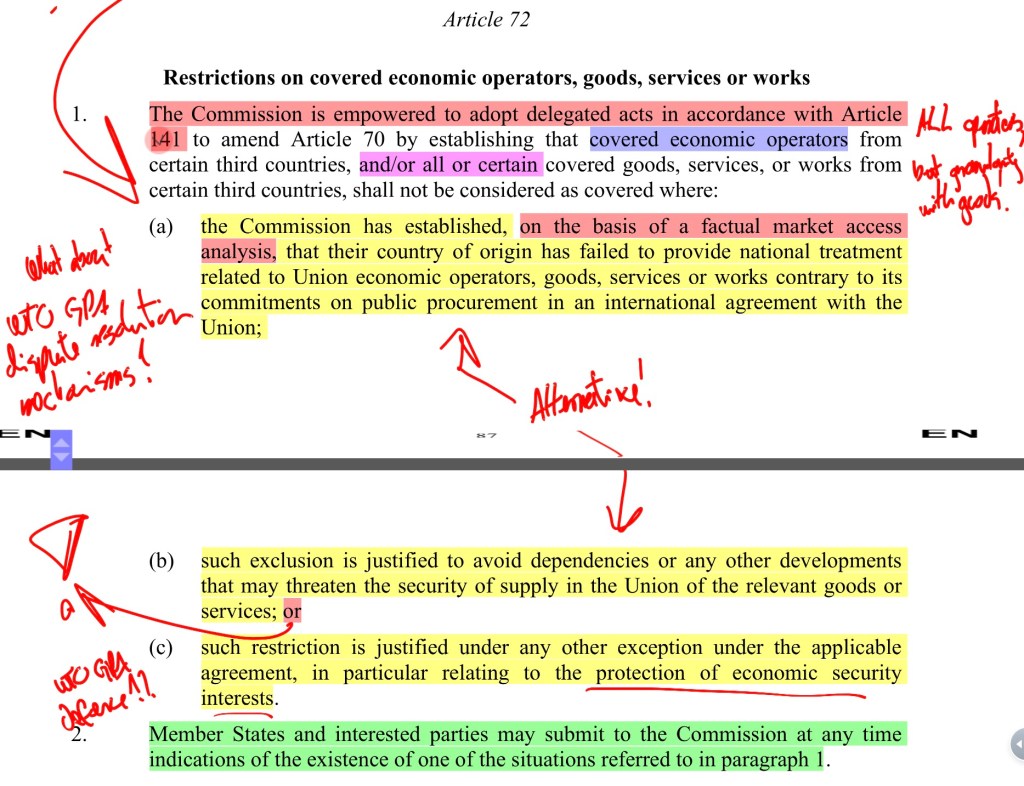
Article 72 is interesting as it gives the Commission the authority to ‘revoke’ covered status already recognized under Article 70 from ‘covered economic operators from certain third countries’ and/or ‘all or certain covered goods, services, or works from certain third countries’. These derogations are therefore to be specific and targeted – they give the Commission the authority to decide on a fairly broad list of possiblities (for example: should only economic operators’ ‘covered’ status be revoked or should this be combined with goods, services and works; or should only ‘goods’ be removed from the ‘covered’ list).
There are three situations where this can be done. The first one deals with situations in which a third country that is a WTO GPA party or has another (reciprocal procurement) FTA or customs union in place with the EU – does not fulfill its obligations to the EU under those agreements. So, when the Commission conducts a factual market analysis and establishes a failure to accord national treatment to EU economic operators, goods, services or works on the third country’s domestic market – revocation of ‘covered’ status may occur. These investigations may be initiated ex officio, but ‘Member States and interested parties may submit to the Commission at any time indications of the existence’ of third country FTA violations or any other bases for ‘covered’ status revocation listed below.
One big problem here is – this provision does not seem to take into account dispute resolution mechanisms provided by plurilateral or bilateral trade agreements. For example – take the WTO GPA. Article XX of the WTO GPA gives the parties access to the Understanding on Rules and Procedures Governing the Settlement of Disputes of the WTO. Therefore, if the Commission believes a third country that is a WTO GPA signatory is not fulfilling its obligations to EU economic operators under this agreement based on a ‘factual market anaysis’ – the first step should be to try to settle the dispute with the tools afforded by the GPA.
Now, these dispute resolution tools might not be effective (especially the WTO GPA one – only a handful of disputes so far – but this is no reason to disregard the applicable procedures.
The second one does not explicitly mention an in-depth investigation (making the Commission’s decision less bound by any evidential threshold), it only requires that such an ‘exclusion is justified to avoid dependencies or any other developments that may threaten the security of supply in the Union of the relevant goods or services’. Here there is no mention of the third country’s fulfilment of FTA obligations, meaning that the Commission may make a political decision to, for example, remove the ‘covered’ status of Japanese goods even though Japan is fulfilling its WTO GPA obligations if the Commission decides that there is an unhealthy dependency on that certain Japanese product or raw material.
I can understand the underlying logic in these two provisions – we are living in a different world than the one 10 years ago, in a world where the rules-based international order is crumbling, free trade agreements are more and more seen as buffets where parties apply only the provisions that suit them, and trade is (even more) weaponised to achieve geopolitical and/or geoeconomic goals. Therefore, we need tools that allow us to act fast(er) and correct these imbalances and violations of FTA obligations as fast as possible. But it is still necessary to acknowledge that these provisions seem to run contrary to the EU’s WTO GPA and other FTA obligations – potentially making the EU just another actor walking away from its international obligations.
The final one is much more straightforward and is much less problematic – the restrictions applied here must be ‘justified under any other exception under the applicable agreement, in particular relating to the protection of economic security interests’. These are the situation where the FTA itself allows for derogations, such as Article III of the WTO GPA. Even though Article III of the WTO GPA has no exception labeled as ‘economic security’, at least it can probably be subsumed under ‘procurement indespensable for national security’ – if you squint a lot.
There is no mention of how ‘covered status’ is restored. It is reasonable to assume a third country whose economic operators, goods, services or works are affected by such a delegated act would at some point want to acquire ‘covered’ status again. Article 72 should therefore introduce a separate paragraph delineating the initiation and conclusion of negotiations, submission of evidence that the third country is now fulfilling its FTA obligations or that the Commission has completed a factual investigation and concluded that the dependencies that threatened security of supply in the EU have been resolved.
One final thing to note – delegated acts under Article 72 (as well as Article 75) are to be ‘adopted in accordance with Article 141’. Article 141 gives the Parliament and/or the Council the authority to ‘revoke at any time’ the Commission’s authority to adopt these delegated acts. While such a decision by the Parliament or the Council represents a useful check on the Commission’s power – it is not retroactive and the already adopted delegated acts remain in force. Furthermore, the entry into force of these delegated acts is dependent on (at least tacit) agreement of both Council and Parilament. If either institutions object – the delegated act will not enter into force. This would require a qualified majority vote in the Council – making it possible for a sceptical group of third country friendly Member States to table the delegated act.


1 Comment Leave a comment ›