Public Procurement Act proposal commentary – Article 70 – Covered economic operators, goods, services or works
(See Pedro’s thoughts on Article 70 here)
Public procurement procedures conducted in a Member State may see three kinds of economic operators: those from Member States (including the Member State where the procurement is conducted), those from countries with plurilateral or bilateral trade agreements in place with the EU that contain procurement provisions/chapters, and those from third countries (if allowed to participate).
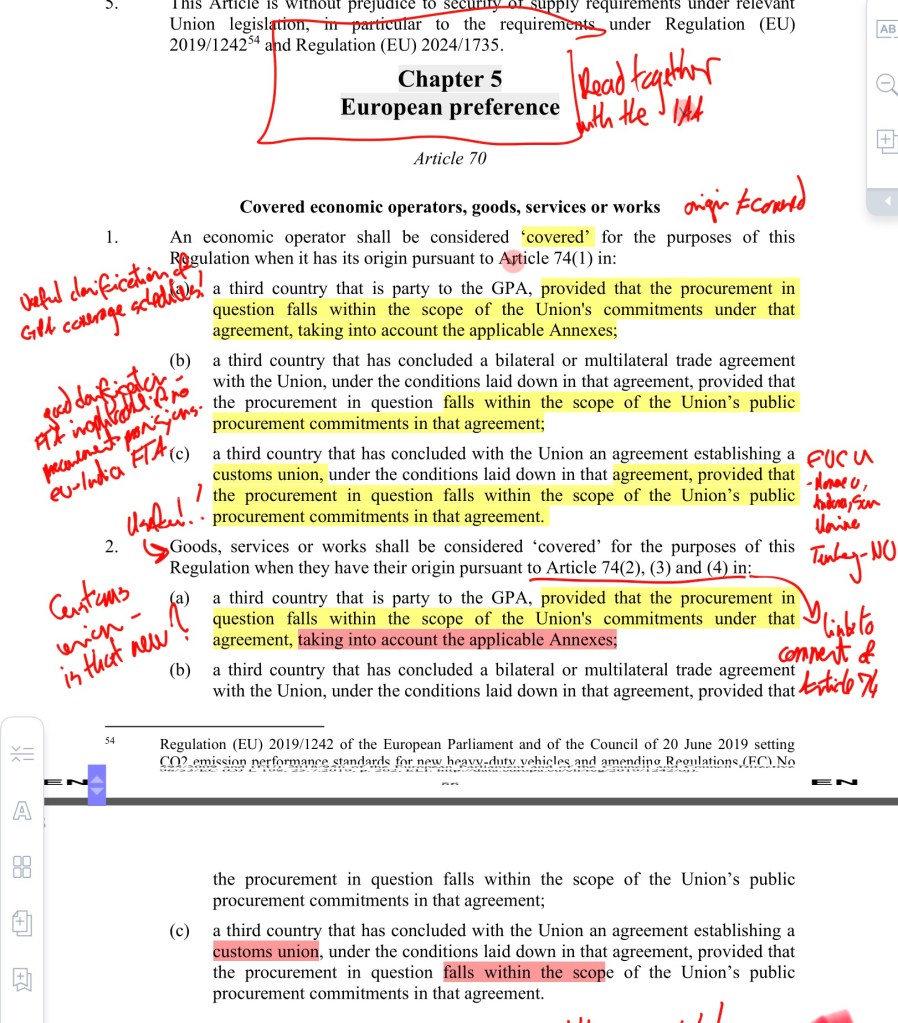
Article 70 defines the second category – ”covered” economic operators. The term is first mentioned in Article 4 (more on that in an upcoming post, and the possible interpretation on Article 4 as a proclamation against intra-EU local content) but is fleshed out here.
Paragraph 1 does a good job of showing how difficult it really is to establish – from one procedure to the next – which economic operators are indeed ”covered” and can participate. Recital 32 shows this clearly:
The existence of market access granted depends on the type of procurement procedure, the nature of the public buyer, the subject-matter of the contract, the applicable thresholds, and the specific carve-outs or horizontal exemptions negotiated in each agreement.
The Commission attempted to address this complexity with its Procurement for buyers online tool, but this will be addressed in detail in the commentary on Article 71.
Recital 32 also explicitly addresses candidate countries. This is relevant for countries with Stabilization and Association Agreements (SAAs) in place like Montenegro or Serbia, but also Moldova, Georgia and Ukraine – as they concluded Deep and Comprehensive Free Trade Agreements (DCFTAs) with procurement provisions. There is some FTA overlap here, as Montenegro, Moldova and Ukraine are also WTO GPA signatories, which makes establishing coverage a bit more complicated on a case-by-case basis.
Recital 32 recognises their ”covered” status, stating that:
This approach reflects the perspective of enlargement and the gradual integration of candidate countries into the Union’s internal market, and is intended to support closer economic integration, encourage regulatory alignment, and strengthen the application of the Union’s rules and standards in its immediate neighbourhood.
This is a welcome clarification, as the issue had previously been raised as a possible problem in literature and there were questions in the South-East European candidate countries is the wake of Kolin and Qingdao are their economic operators allowed full ”covered” access to the EU public procurement market. But candidate status does not by itself establish coverage. An agreement needs to be negotiated and in force.
Paragraph 1 differentiates WTO GPA countries, countries with other FTAs with public procurement provisions in place, and countries that share a customs union with the EU.
A couple of things need to be flagged:
- Economic operators from WTO GPA signatory countries will not automatically gain access to any public procurement procedure within the EU – this depends on the value of the procurement (whether it is above the WTO GPA thresholds), and the EU’s WTO GPA coverage schedules under Annexes 1, 2, 3, 4, 5, 6 and 7.
- The fact that a country signed an FTA with the EU does not mean that its economic operators are automatically ”covered” – the FTA in question needs to have a public (government) procurement chapter. For example – even though India and the EU recently negotiated an FTA – as it does not have a government procurement chapter – Indian economic operators will still not be considered covered after the FTA is in force.
- The same is applicable for countries with customs union agreements with the EU. Turkiye is a good example – there is a customs union agreement in place but Turkish economic operators are still not covered.
But Article 70 does not stop at ”covered” economic operators, it also defines ”covered goods, services and works” in paragraph 2. While this is a good and useful clarification, conceptually this is nothing new as Article 25 of the Classical Directive and Article 43 of the Utilities Directive clearly addressed both supplies and services together with non-covered economic operators. Also Article 85 of the Utilities Directive provided a mechanism concerning tenders containing non-covered products.
Still, this is a very welcome addition as in the wake of Kolin and Qingdao there were a lot of questions about whether the conclusions from these judgments applied beyond economic operators alone. Article 70 clears up this dilemma, but must be read together with Article 74. For now I can say it leaves a lot of ambiguity still. The ”covered” rules for goods, services and works closely mirror those for economic operators. Where they differ is the mechanism to establish the origin of economic operators on the one hand and goods, services and works on the other. This is established in Article 74, which leaves some important unresolved questions.
A couple of stray observations that will be covered in future posts but are worth mentioning here:
- As contracting authorities are not infallible, there will be mistakes in establishing whether an economic operator is covered, and whether goods are covered. So if an economic operator is excluded based on origin, it has to have a right to appeal – claiming it has ”covered” status. But if it has ”covered” status, or, its ”covered” status is not yet established – it should be protected by EU law, national law transposing EU law and the Charter of Fundamental Rights of the EU (CFREU). Therefore – it should have access to standard national public procurement remedies and appeal bodies and courts. But what happens if an appeal body decides it is not ”covered”? Is this determination applicable to each and every future public procurement procedure? Probably not for all economic operators, as ”covered” status is fluid to a point – especially for economic operators from WTO GPA and FTA countries. This issue is especially important for economic operators from countries such as Turkey and China. Therefore – it is possible for them to have access to standard procurement remedies and be protected by EU law if and when disputing their non-covered status, and have basically no legal protection if admitted to a procurement procedure as non-covered economic operators.
- There will be interesting situations depending on what the contracting authority does – if it decides to exclude both non-covered economic operators and goods or just one of the two. If it allows non-covered operators but not non-covered goods in its IT equipment procurement – Chinese economic operators could only tender equipment manufactured in covered countries. But if it excludes non-covered operators and allows non-covered goods – a Croatian company could tender Chinese computers. But maybe my Polish colleagues have more experience with these issues as I remember the Polish UZP’s Q&A from 2025 had interpretations concerning third-country goods exclusion.


5 Comments Leave a comment ›