Problems with social responsibility, self-reporting and data in public procurement
Our socially responsible public procurement (SRPP) project has entered its second year, which means it’s time to start analysing the data – hundreds of thousands of Croatian contract notices from 2016 to 2026.
Now, what we’ll exactly search for in the notices is still being discussed, but the goal is to identify indicators of deliberate use of socially responsible procurement measures by contracting authorities, so to avoid including template reproduction. The most likely things we’ll end up searching for are reserved contracts, discretionary SRPP exclusion grounds and most economically advantageous tender SRPP weights (for example so far we found 10-30% weights concerning collective bargaining; Fair Trade labels; paying transportation costs, Christmas and/or Easter bonuses to workers; employing members of socially vulnerable groups; gender balance in the workforce; and an interesting one – additional points if the number of work-related injuries is low in the last three years). Another useful addition (at least at first glance) are the ‘Strategic procurement’ checkboxes in the ‘new’ Croatian Electronic public procurement portal (EOJN). If the contracting authority selects it – it can state if it used green or socially responsible elements in the said public procurement procedure. This option has been available only in the last couple of years.
As a test, we analysed 15k contract notices from the last 12 months, trying to see how often do contracting authorities self-report socially responsible procurement elements, and what do they perceive as such. Here is a table:
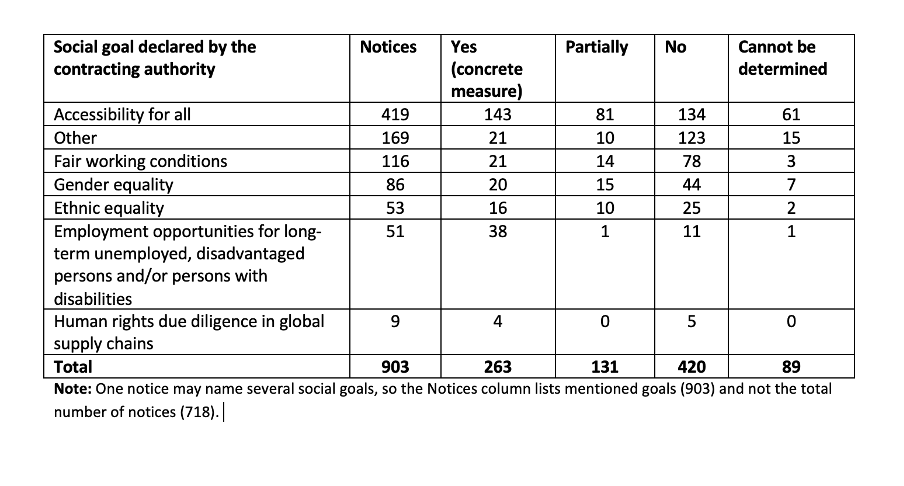
The table shows only 718 contract notices with reported SRPP elements out of 15,000 analysed, which makes only around 5% of the sample. We analysed contract notices, instructions to tenderers, technical specifications or any other document the contracting authority is referring to in the notice to see if it supports the contracting authority’s socially responsible claim.
The results are….mixed. While we identified 718 contract notices, 903 are listed in the table as some notices contain several socially responsible elements. Out these 903, we confirmed a socially responsible measure in only 263, while a further 131 were only partially substantiated!
Even more interesting is the fact that out of 718 notices – 419 list ‘accessibility’ as a socially responsible criterion. While accessibility IS listed in Article 42 of the Classical directive (technical specifications) and could TECHNICALLY be considered socially responsible – it is also mandatory (subject to limited exceptions). You can’t build today without making the building wheelchair accessible or purchase a bus without considering accessibility. Interestingly, the vast majority of procurements with accessibility as a SRPP criterion listed are works, construction related services (design documentation, construction supervision, coordination of works) and vehicles (buses, vans). So maybe this isn’t something that should be reported in the statistics any more than demanding tenderers to pay their taxes as a prerequisite for participation – as both may be considered socially responsible – but are mandatory legal prerequisites.
This is one of the things we need to keep in mind when reading yearly national public procurement statistics, as they (especially in green and socially responsible) rely on self-reporting. We know that self-reporting is not ideal, and this is made worse by over-reporting such as the one described here.
If we want an accurate overview of the use of socially responsible criteria in public procurement the EOJN form needs to distinguish mandatory SRPP elements from discretionary/intentional ones – as only the latter show the contracting authority’s resolve to purchase with social responsibility in mind. This would help prevent mandatory SRPP compliance from being counted and make unsupported declarations easier to identify. And we need to dedicate more time to strategic procurement goals in our procurement training courses, empowering contracting authorities to differentiate meaningful implementation from stat padding in the yearly reports. A good analogy might be a gender responsive procurement example I remember form a while back – purchasing additional lighting in parks so women would ‘feel safer using them at night’.


