Public Procurement Act proposal commentary – Article 73 – European preference requirements
(See Pedro’s thoughts on Article 73 here)
Article 73 is the meat and potatoes of the ‘European preference’ chapter, or at least it should be. But for a carnivore, it leaves a tofu aftertaste (apologies to my vegetarian and vegan friends, I couldn’t resist).
I’ve written about my issues with the way the Commission decided to address Kolin and Qingdao in the introductory post to this commentary, and a lot of the problems I addressed there are very much visible here. Therefore, I would like to begin this post with some thoughts on discretion.
Barring delegated acts adopted by the Commission (under Article 75, like those allowed by Article 72), contracting authorities are free to decide whether to implement ‘European preference requirements’ or not, and in which way those preferences might be implemented. It is difficult to imagine an effective external dimension of EU procurement law and an effective uniform EU-wide approach to public procurement international trade issues when every contracting authority can pull in its own direction. This discretion is not only problematic from an international trade standpoint, as it even seeps into the conduct of the public procurement procedure and causes rule of law and transparency issues – which will be discussed in detail below.
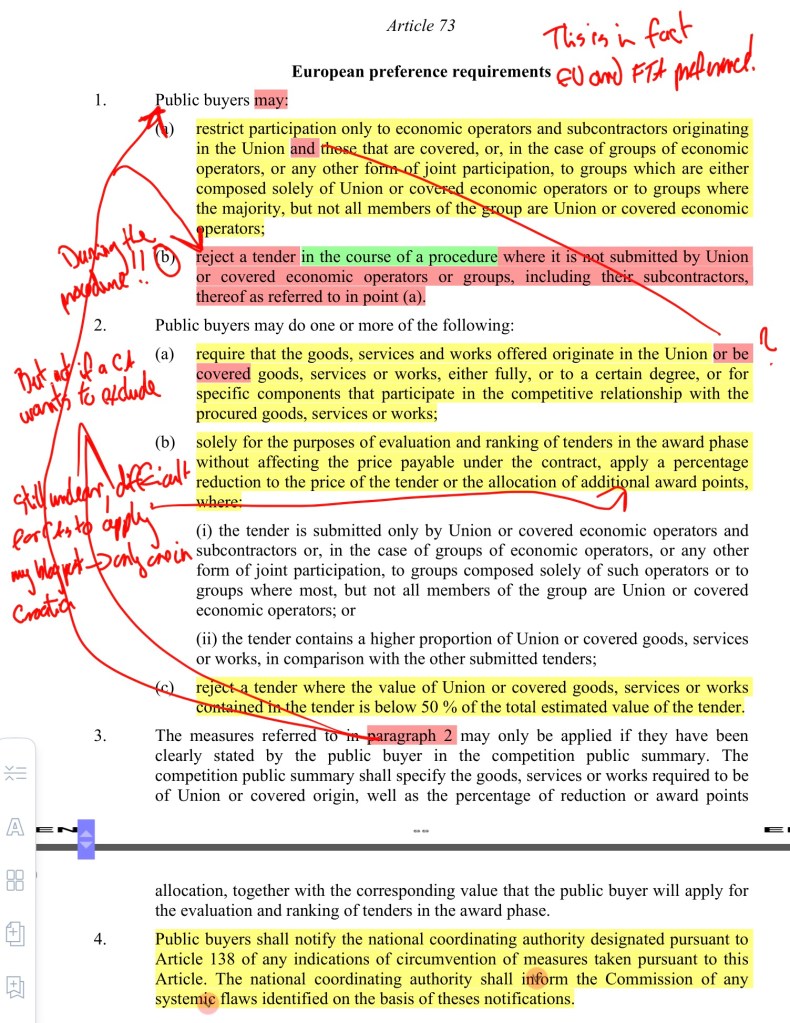
The first ‘may’ – paragraph 1(a) – allows contracting authorities to reserve participation for only EU AND economic operators from other covered countries. Another layer of differentiation exists with groups of economic operators: contracting authorities may reserve participation only for those composed exclusively of EU and other covered economic operators, or for those where the ‘majority, but not all’ members of the group are covered.
Things go off the administrative procedural law rails with the next ‘may’ – paragraph 1(b). Contracting authorities may ‘reject a tender in the course of a procedure where it is not submitted by Union or covered economic operators or groups, including their subcontractors’. This represents a continuation of the Commission’s view from the controversial 2025 non-paper – contracting authorities may exclude non-covered economic operators at any time during the procedure. I wrote about the dangers of this unfortunate stance; here is a paragraph from my comments on the Commission non-paper (for a more detailed comment see this book chapter):
According to the Commission – this means that contracting authorities have the discretion to abandon even the minimum of transparency towards third-country economic operators – meaning they can ‘change the rules of the game’ – any time they want. This is a dangerous conclusion, because it opens the door to other disproportionate discriminatory behaviour, but also undoubtedly violates national transparency and proportionality principles and guarantees established in national administrative procedural and/or civil procedure acts. No contracting authority should follow this recommendation – the intent to exclude third-country economic operators should always be clearly stated in the procurement documentation.
While this is problematic in itself, paragraph 3 prescribes that ‘European preference requirements’ can only be applied ‘if they have been clearly stated by the public buyer in the competition public summary’. But this provision only applies to paragraph 2, but not for the above-described restrictions on participation and rejections of tenders in paragraph 1. This means that contracting authorities may decide to exclude non-covered economic operators even if such a decision was not mentioned in the tender notice (competition public summary) – eroding transparency even more. This is not an oversight – but a clear and purposeful continuation of the Commission’s thinking from the 2025 non-paper mentioned above. Furthermore, this is a point where the PPA proposal is diverging from Kolin and Qingdao (not the divergence I hoped for) – as those judgements do not support exclusions mid-procedure. An excerpt from my book chapter:
The CJEU discussed the possible timing of the announcement of exclusion of third-country economic operators and the implementation of score adjustments in Paragraph 63 and 64 of Kolin. According to these paragraphs of the Kolin judgment, score adjustments must be included in procurement documentation at the beginning of the public procurement procedure. Therefore, it is not allowed to implement score adjustments at any other time after the tenders have been submitted, as this would severely violate the principle of transparency and substantially change procedural rules in a way that would have significant effect on the viability of third-country economic operators’ tenders. Accordingly, I see no possibility for an interpretation that the decision to exclude third-country economic operators can be made after tender submission.
If a contracting authority decides to implement score adjustments, this means that it wishes to allow third-country economic operator participation. Allowing the contracting authority to ‘change its mind’ in such a significant way later severely violates the principles of transparency, legal certainty, and legitimate expectations with regard to third-country economic operators, but also to the entire public procurement procedure. This is further confirmed by Paragraph 63 of Kolin, where the CJEU states that it is up to the contracting authority to decide whether third-country economic operators ‘should be admitted to a public procurement procedure’, which seems to suggest the decision on participation must be made at the beginning of the public procurement procedure. If the intention was for the contracting authorities to have the ability to exclude on the basis of economic operator origin at any time during the public procurement procedure, the CJEU would have used different wording.
If the Commission’s interpretation of Kolin and Qingdao does not have basis in the judgments themselves, this means that the Commission is independently creating a new interpretation of EU law.
And now to the final issue of paragraph 1, a new one which adds another unwanted layer of procedural complexity and opacity in contracting authorities’ decision-making – ‘Public buyers may reject a tender in the course of a procedure’. A logical (at least to me) reading of this provision leads to the conclusion that a contracting authority may decide to reject a tender from only one of the participating ‘non-covered’ economic operators – leaving the rest in. So, if two Chinese and two Indian economic operators submit tenders – the contracting authority may (MID PROCEDURE AND WITH NO STATEMENT IN THE COMPETITION PUBLIC SUMMARY ):
- exclude them all, or
- reject only the Chinese tenders, or
- reject only the Indian tenders, or
- reject just one of the two Chinese tenders and leave the other one and the two Indian ones – in, or
- reject just one of the two Indian tenders and leave the other one and the two Chinese ones – in.
An incredible amount of discretion is given to contracting authorities – this layered approach to economic operators from different ‘non-covered’ countries and even to economic operators from the same ‘non-covered’ country goes beyond the discretion given by the CJEU in Kolin and Qingdao. The corruption potential cannot be ignored.
Interesting differentiation in paragraph 2(a) regarding goods, services and works – contracting authorities may require them to originate in the Union OR be covered. While it is impossible to restrict participation of ‘covered’ economic operators, the wording here is unclear and it might be possible to interpret this as allowing restricting the acceptance of covered goods, services or works. This also seems to go against WTO GPA and FTA obligations. As for ‘specific components that participate in the competitive relationship with the procured goods, services or works’ – I don’t know what those specific components might be, and what the nature of their ‘competitive relationship’ is with the procured goods, services or works – and this is something Pedro and I agree on.
While Kolin and Qingdao (re)introduce the concept of score adjustments (reduction of evaluation scores for ‘non-covered’ economic operators), the Commission goes in a different but essentially the same direction by establishing price reductions and point increases. Both are again discretionary but are also reserved for covered economic operators (see below for possible applications beyond covered operators). They are therefore tools of positive discrimination. Contracting authorities may:
- apply a percentage reduction to the price of the tender (without affecting the price payable under the contract), or (it looks like you can’t do both in the same procedure)
- allocate additional award points.
It seems to me the percentage reduction of the price of the tender might be a less potent option when considering that the weighting of quality criteria would normally have to be at least 30% or even 50% in labour-intensive contracts under Article 98 (but this might make more sense if the contracting authority uses Article 98 paragraph 5 derogations). So, if a contracting authority wants to ‘positively discriminate’ – additional award points might be a better option. There is no clearly prescribed numerical range for additional award points or price reductions – which (still) leaves the door open for symbolic measures (like in Kolin and Qingdao). Article 98(2)(b) frames award points within quality criteria – meaning it can be used as one of the quality weights within the minimum 30-50% range (if no derogations are applied).
Price percentage reductions and additional award points should only be applied (at least at first glance) if the tender is submitted by EU or covered economic operators. If the tender is submitted by a group – either all members must be ‘covered’ or most of them must be, or if the tender in question ‘contains a higher proportion of Union or covered goods, services or works, in comparison with the other submitted tenders’. This leaves the door open for preferential treatment of non-covered economic operators. If the contracting authority did not exclude them, and if they tender a higher proportion of Union or covered goods, services or works in comparison with other tenders – they may receive a price percentage reduction or be allocated additional points. Also, paragraph 2(c) allows for rejecting a tender submitted by a covered economic operator, as it allows rejection ‘where the value of Union or covered goods, services or works contained in the tender is below 50 % of the total estimated value of the tender.’ Therefore, a Croatian economic operator’s tender can be rejected if, for example, over 50% of the IT equipment tendered originated in China.
Paragraph 4 establishes a loose (no timeline, format or criteria for identifying ‘systemic flaws’) reporting mechanism for circumvention of Article 73 measures if a contracting authority decides to implement them (or must implement them under a Commission delegated act adopted in accordance with Article 75). Circumvention could probably entail intentional misrepresentation of economic operator origin or of the goods offered. If noticed, contracting authorities have an obligation to report this to the ‘national coordinating authority’ designated in the Member State according to Article 138 (this will probably be the Ministry of Economy, Directorate for Public Procurement Policy in Croatia). This authority then has the obligation to ‘inform the Commission of any systemic flaws identified on the basis of theses (probably a typo – should be ‘these’) notifications.’ So, it looks like it isn’t necessary to give a report on all attempted circumventions in a given Member State – but only a collated report on ‘systemic flaws’ – a term that needs a definition.
Reading paragraphs 1 and 2 together leaves the impression of almost infinite possibilities given to contracting authorities. They can (and this is not an exhaustive list):
- restrict participation to only covered economic operators,
- if groups are involved – limit participation to only those groups where all members are covered or also allow those where the majority is,
- reject a tender in the course of a procedure where it is not submitted by Union or covered economic operators or groups, including their subcontractors,
- the measures under paragraph 1 DO NOT NEED TO BE CLEARLY STATED IN THE TENDER NOTICE (competition public summary)
- require that the goods, services and works offered be Union or covered goods, services or works – fully,
- require that the goods, services and works offered be Union or covered goods, services or works – to a certain degree,
- implement a percentage reduction to the price of the tender of covered economic operators,
- implement a percentage reduction to the price of the tender of non-covered economic operators (if they are tendering an adequate amount of covered goods),
- allocate additional award points to covered economic operators,
- allocate additional award points to non-covered economic operators (if they are tendering an adequate amount of covered goods),
- reject a tender from a non-covered economic operator where the value of Union or covered goods, services or works contained in the tender is below 50 % of the total estimated value of the tender,
- reject a tender from a covered economic operator where the value of Union or covered goods, services or works contained in the tender is below 50 % of the total estimated value of the tender,
- exclude non-covered economic operators but allow non-covered goods, services and works,
- it is even possible to exclude non-covered economic operators and apply a percentage reduction to the price of the tender or the allocation of additional award points to the tenders of remaining covered economic operators (which would appear to be nonsensical but it isn’t – as covered economic operators might offer various quantities of covered goods!
I think I made my point, and we can agree that the possibilities are…substantial – before even taking into account Article 76 exceptions contracting authorities may apply. This does not scream ‘simplicity’, and the result will likely be – very limited use of Article 73 by contracting authorities (if no Commission delegated acts are introduced).
This is the second ‘European preference’ Article with rule-of-law concerns. While Article 72 allows the Commission to unilaterally violate international trade agreements, Article 73 is incompatible with administrative procedure standards: participation may be restricted even if this was not advertised in the competition public summary – and contracting authorities may even cherry-pick which of the non-covered economic operators tenders they want to exclude. This makes the external dimension of public procurement an exercise of contracting authority discretion akin to me playing chess with my 5-year-old. I think both of us should be aware of the rules going in – but my son loves to make the bishop move like a rook as the game unfolds.


