Public Procurement Act proposal commentary – Article 74 – Origin
(See Pedro’s thoughts on Article 74 here)
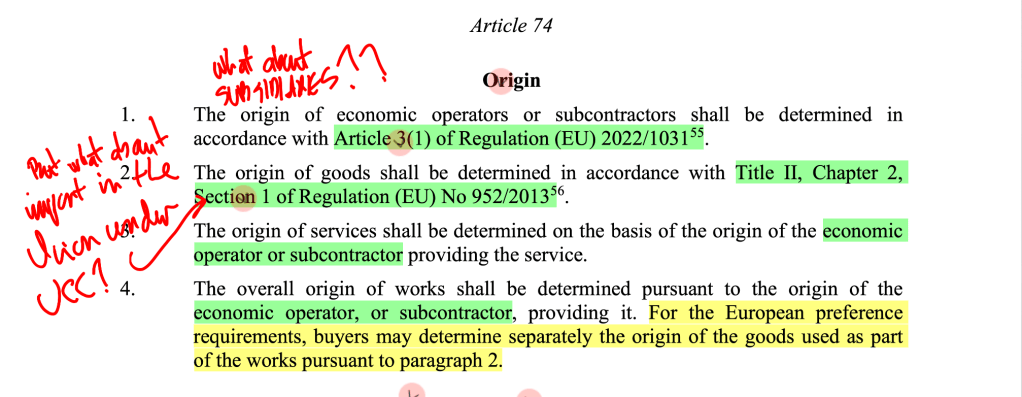
Article 70 determines coverage – which economic operators, goods, services and works will be considered covered (having equal access to the EU public procurement market) – and coverage is established by origin. Therefore, Article 70 is impossible to read in a vacuum, as Article 74 establishes rules on origin.
The determination of origin is ‘outsourced’ to two other Regulations, and the origin of economic operators, goods, services and works is divided into two categories.
The origin of economic operators, services (origin determined on the basis of the origin of the provider) and works (origin determined on the basis of the origin of the economic operator or subcontractor providing the works) is determined in accordance with Article 3(1) of the International Procurement Instrument (IPI), while the origin of goods is determined in accordance with Title II, Chapter 2, Section 1 of the Union Customs Code.
Establishing the origin of economic operators is tricky and important, especially when dealing with subsidiaries of non-covered economic operators established in a Member State. The Romanian legislative amendments that served as the basis of the national case from which the reference for preliminary ruling in Qingdao originated clearly show that this is a significant practical issue. The Romanian Government Emergency Order No 25/2021 (GEO) introduced a new definition of economic operators in 2021. This definition created an obligation for Romanian contracting authorities to exclude non-covered economic operators from every public procurement procedure. And despite a clear obligation to exclude, non-covered economic operators continued to participate in Romanian public procurement procedures. This is especially evident by the fact that the Commission conducted foreign subsidies investigations against Chinese economic operators participating in a Romanian public procurement procedure in 2024 – while the national ban on non-covered economic operator participation was in effect.
So, let’s take a look at Article 3(1) of the IPI:
1. The origin of an economic operator shall be deemed to be:
(a) in the case of a natural person, the country of which the person is a national or where that person has a right of permanent residence;
(b) in the case of a legal person, either of the following:
(i) the country under the laws of which the legal person is constituted or otherwise organised and in the territory of which the legal person is engaged in substantive business operations;
(ii) if the legal person is not engaged in substantive business operations in the territory of the country in which it is constituted or otherwise organised, the origin of the legal person is to be that of the person or persons who may exercise, directly or indirectly, a dominant influence on the legal person by virtue of their ownership of that legal person, their financial participation therein, or the rules which govern that legal person.
(…)
I’ve written about my misgivings with this definition here, here and here. The gist of it is that it allows non-covered economic operators to ‘circumvent’ their status by establishing subsidiaries. A Turkish construction economic operator can establish a subsidiary in Croatia, under Croatian law and this subsidiary can engage in ‘substantive business operations’ in Croatia (see the IPI Guidelines to see what ‘substantive business operations are’). The Turkish parent company can retain dominant influence, which means that under Article 3(1)(b)(i) this subsidiary will be considered covered as the dominant influence check kicks in only if the subsidiary is not engaged in ‘substantive business opeerations’ in the Croatian market.
Now this can be a legitimate political decision: allowing non-covered economic operators to participate in EU procurement procedures via subsidiaries may encourage investment and employment in the EU, increase the number of bidders and increase collective bargaining coverage within the Member State where the subsidiary is incorporated.
But there are significant trade-offs: weakening of reciprocity and FTA negotiating leverage, leaving strategic decision-making in a third country via dominant influence of the parent company, subsidies by the third-country parent company, and potential limited contribution to EU economy (as a contract awarded to such a subsidiary does not necessarily guarantee a real contribution to EU employment, production or technological capacity).
Regarding goods, Title II, Chapter 2, Section 1 of the Union Customs Code has 5 Articles (59-63), but for the sake of brevity let’s just take a look at Article 60:
1. Goods wholly obtained in a single country or territory shall be regarded as having their origin in that country or territory.
2. Goods the production of which involves more than one country or territory shall be deemed to originate in the country or territory where they underwent their last, substantial, economically-justified processing or working, in an undertaking equipped for that purpose, resulting in the manufacture of a new product or representing an important stage of manufacture.
The Commission decided to refer to UCC origin rules, and not ‘Union goods’ rules. This is not new, as Recital 12 of the International Procurement Instrument also points to Article 60 UCC to determine the origin of goods.
Both origin rules and ‘Union goods’ rules serve a specific function in the UCC, but the legislative choice made here may create practical issues for goods legally imported into the EU.
Article 5(23)(b) UCC defines ‘Union goods’ as ‘goods brought into the customs territory of the Union from countries or territories outside that territory and released for free circulation’, while Article 201 defines the prerequisites for ‘free circulation’ (import duty collection, collection of other charges, application of policy measures and prohibitions and completion of any other formalities). After this is done – ‘release for free circulation shall confer on non-Union goods the customs status of Union goods.’
This brings us to Article 28 TFEU:
28(1)The Union shall comprise a customs union which shall cover all trade in goods and which shall involve the prohibition between Member States of customs duties on imports and exports and of all charges having equivalent effect, and the adoption of a common customs tariff in their relations with third countries.
28(2) The provisions of Article 30 and of Chapter 2 of this Title shall apply to products originating in Member States and to products coming from third countries which are in free circulation in Member States.
Which further brings us to Commission v Czech Republic para 37:
The Court has concluded that, as regards free movement of goods within the EU, goods in free circulation are definitively and wholly assimilated to goods originating in the Member States and that the provisions of Article 34 TFEU consequently apply without distinction to products originating in the EU and products put into free circulation in any of the Member States, whatever the real origin of the products (…).
After goods originating in non-covered countries are imported into the EU and are put into free circulation – they acquire ‘Union goods’ status. For the purposes of free movement within the EU, those goods are assimilated to goods originating in Member States. While ’free circulation’ in the most literal sense is meant as a ban of quantitive restrictions on imports – the reason they are imported is commercial – they are to be sold and bought in the internal market. And if those goods are allowed to ‘freely circulate’ in the private market and not the ‘public (procurement)’ one – are they really ‘freely circulating’?
This is where an analogy with economic operator origin (discussed above) might be useful. Article 3(1) IPI seems to allow the participation of non-covered economic operator subsidiaries in EU public procurement procedures – legal persons established within the EU under the incorporation laws of a Member State. Subsidiaries can therefore be seen as an ‘extension’ (a loose analogy) of non-covered legal persons that have achieved ‘free circulation’ status – and as such have the right to participate with no restrictions (provided they satisfy the ‘substantive business operations’ requirement) in EU public procurement procedures. And we decide to ignore the ‘dominant influence’ the non-covered parent company still may hold. But if this is allowed for economic operators – why are goods treated differently, and why are ‘Union goods’ subjected to possible restrictions and/or exclusions in EU public procurement procedures?
These are not identical legal and economic situations of course, and the decision to go in different legal directions here may be political and/or practical. It can also be tied to economy issues, as subsidiaries may offer much more benefit to Member State and EU economy than imported goods (even though allowing ‘Union goods’ to be tendered in EU public procurement procedures has its economic benefits too). But I still believe this distinction needs to be addressed, and that any (potentially valid) practical reason to approach subsidiaries and ‘Union goods’ differently does not resolve the tension that exists between the provisions of Article 74 of the PPA proposal with Article 201 UCC and Article 28 TFEU.
Also – it seems to me that Article 74 rules on goods origin expose certain tensions between Article 28 and 34 on one hand and Article 207 TFEU (common commercial policy) on the other – but this is a question that deserves to be explored in a full-length paper, not a blogpost.


1 Comment Leave a comment ›