Public Procurement Act proposal commentary – Introduction
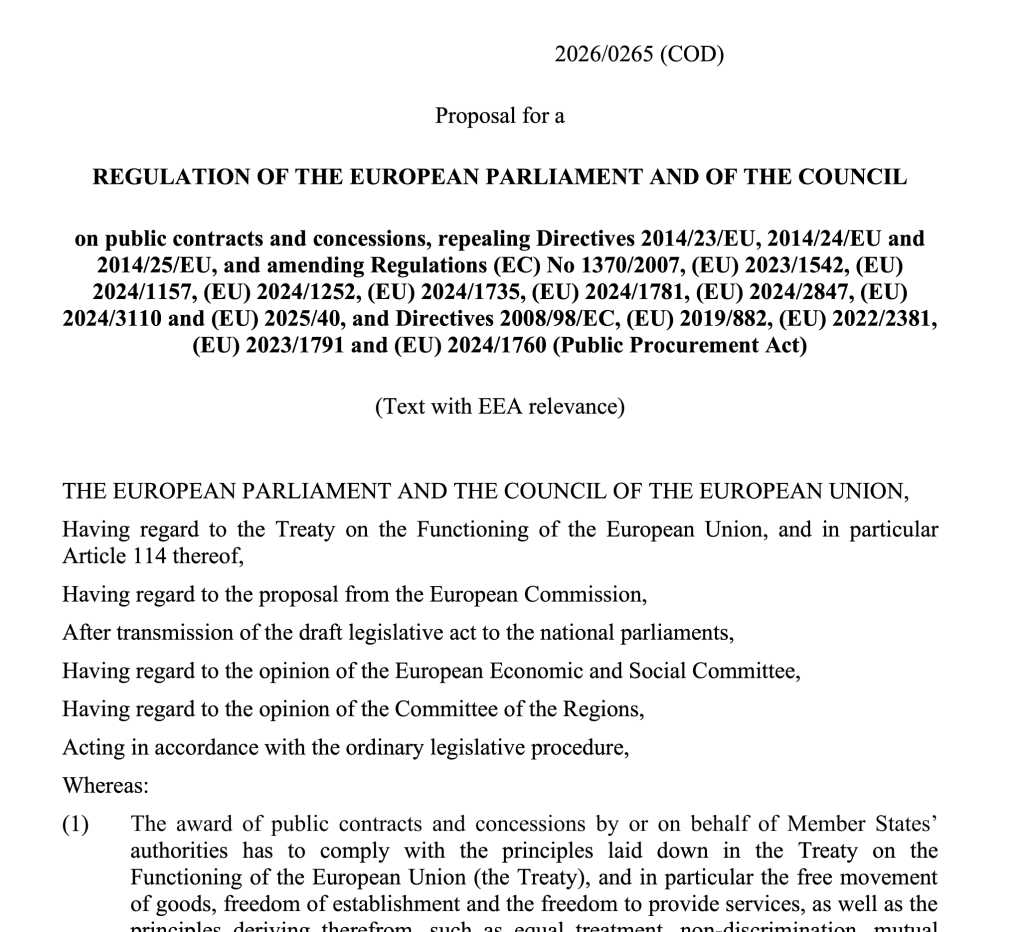
This is exciting! Pedro and I are very happy to share with you that we will be writing a commentary of the Public Procurement Act proposal! We talk an unhealthy amount every day – so we might as well do something constructive! You can read Pedro’s initial thoughts here.
How will this work, you asked? Well, probably not how you would expect. We will not begin with Article 1, and not every Article will get individual treatment (sometimes we’ll comment an entire section in one go). But all our posts will be published at the same time on our blogs (this is Pedro’s), with cross-referencing links between the two – so you can get two perspectives on the same topic at the same time. As for posting frequency – no promises, but there should be (at least) one post each per week.
On Thursday we are starting with Article 70, the first of the ”European preference” Articles. It seems to us this is the best place to start, as this ”buy European” push has been generating a lot of interest from contracting authorities and economic operators within and (especially) beyond the EU.
But before diving into Article 70, I will use this opening post as an opportunity to give some general thoughts on ”European preference” but especially on the Public Procurement Acts (PPA) ”treatment” of CJEU case-law that profoundly influenced ”European preference” – the Kolin and Qingdao judgment.
I’m not a fan of the judgements (a friend told me once that I’m ”building a career on the things I hate”, and he’s probably right), and have written extensively on this in the past two years here, here, here and here.
But to keep things short, Kolin and Qingdao give too much discretion to contracting authorities (making it impossible to implement an uniform EU-wide approach), bring significant legal uncertainty when deciding which law is applicable to third-country economic operators allowed to participate in a given public procurement procedure, and most importantly – they make it possible (and the Commission endorsed this view in 2025) to deny public procurement remedies to third-country economic operators – which cast a shadow of illegality on that public procurement procedure as a whole.
Therefore, Kolin and Qingdao cannot serve as a foundation of the upcoming PPA. A quote from a position paper I wrote a while back:
The starting point of the revision must be an assessment of the framework created by the Court of Justice in Kolin (C-652/22) and Qingdao (C-266/22): Kolin and Qingdao should, for the most part, be abandoned. The Commission is not obliged to follow them, but it does need to address the question they raise comprehensively — taking full account of Article 2(1) TFEU (pre-emption), Article 4(3) TEU (sincere cooperation) and Article 47 of the Charter of Fundamental Rights (the right to effective judicial protection). Three considerations are relevant.
First, the judgments are, by their own terms, temporary. Paragraph 63 of Kolin opens with the words “in the absence of acts adopted by the European Union”: the discretion the Court conferred on contracting authorities exists only until the EU legislates. These are not only poor judgments; there is a strong case that they were never meant to be the foundation for future EU legislation, nor the definitive answer to the third-country problem.
Second, if the Commission nevertheless chooses to follow Kolin rather than depart from it, paragraph 61 is important. It gives the legislator exactly three options: guarantee access, exclude entirely, or allow participation subject to mandatory score adjustments. If the new Regulation invokes Kolin and Qingdao, these are the only options available to it. And because the discretion the Court established is temporary — lasting only until the EU legislates comprehensively — retaining a similar level of discretion in the new Regulation while simultaneously invoking Kolin and Qingdao would run directly counter to the judgments themselves.
Third, the current situation amounts to a constitutional deficit: exclusive competence without comprehensive legislation. The Court confirmed that third-country economic operator access falls within the EU’s exclusive competence under the common commercial policy (Articles 3(1)(e) and 207 TFEU). Member States are displaced from legislating, yet the EU has legislated in fragments — the IPI, the FSR and the ACI, each investigation-based and situation-specific. The result is that contracting authorities across twenty-seven Member States decide ad hoc, case by case, without a general framework — producing the fragmentation that the conferral of exclusive competence was designed to prevent, undermining the effectiveness of the common commercial policy and the EU’s credibility in negotiating reciprocal trade agreements. Sector-specific selectivity — the “certain strategic sectors” phrase running through the draft Industrial Accelerator Act — institutionalises this deficit.
What would be untenable in the new Regulation is permissive language — “should”, “could” — combined with continued ambiguity on remedies for third-country economic operators. Leaving so many third country and Buy European provisions optional and hedging that discretion by reserving the right to take a stronger stand through future delegated acts, does not solve the problem. Stronger wording is needed from the start.
The Commission decided to go in a different direction.
Recital 33 of the draft PPA seems to enshrine Kolin and Qingdao as principles of the new procurement legislation:
In line with the case law of the Court of Justice of the European Union, in particular its judgments in Case C-652/22 (Kolin) and Case C-266/22 (Qingdao), the rights and principles derived from Union public procurement law do not extend to economic operators, goods, services or works originating in third countries that are not covered by such international commitments. The same principle should apply also to goods, including components of products procured, services or works originating in such countries. Building on this principle, this Regulation enables public buyers to apply European preference requirements, in line with the Union’s international obligations.
While I was hoping for a different Recital in the PPA, this one will give me more to write about. It seems to me that the consequences of this Recital for EU public procurement law will be significant. It brings forward all the problems Kolin and Qingdao caused – fragmentation is here to stay (but that much is obvious from the draft IAA and the European preference chapter of this version of the PPA), and this is difficult to reconcile with Recital 1 of the draft PPA, which claims that one of the most important goals of this Regulation is to:
eliminate obstacles to the functioning of the internal market and prevent the emergence of new ones in the form of regulatory divergences between Member States, including as regards the pursuit of strategic policy objectives.
Furthermore, this Recital binds Kolin and Qingdao to the future revision of the Remedies Directive. I find it very difficult to imagine a Remedies Directive that guarantees equal legal protection to all participants of a public procurement procedure if the PPA already enshrined Kolin and Qingdao as a valid framework of third-country economic operator participation.
But not everything is bad of course, far from it (I’m a glass-half-empty person so I decided to start with the bad). The choice of legislative instrument is a big step in the right direction (and it even seems Member State opposition is subsiding), I like the simplification and reduction of available procedures, a lot of effort was obviously put into the digital and data aspect. All of this will be the subject of future posts.
But for now, expect two parallel posts on Article 70 on Thursday!


2 Comments Leave a comment ›