Public Procurement Act proposal commentary – Article 71 – Determining the scope of coverage for third-country covered economic operators, goods, services or works
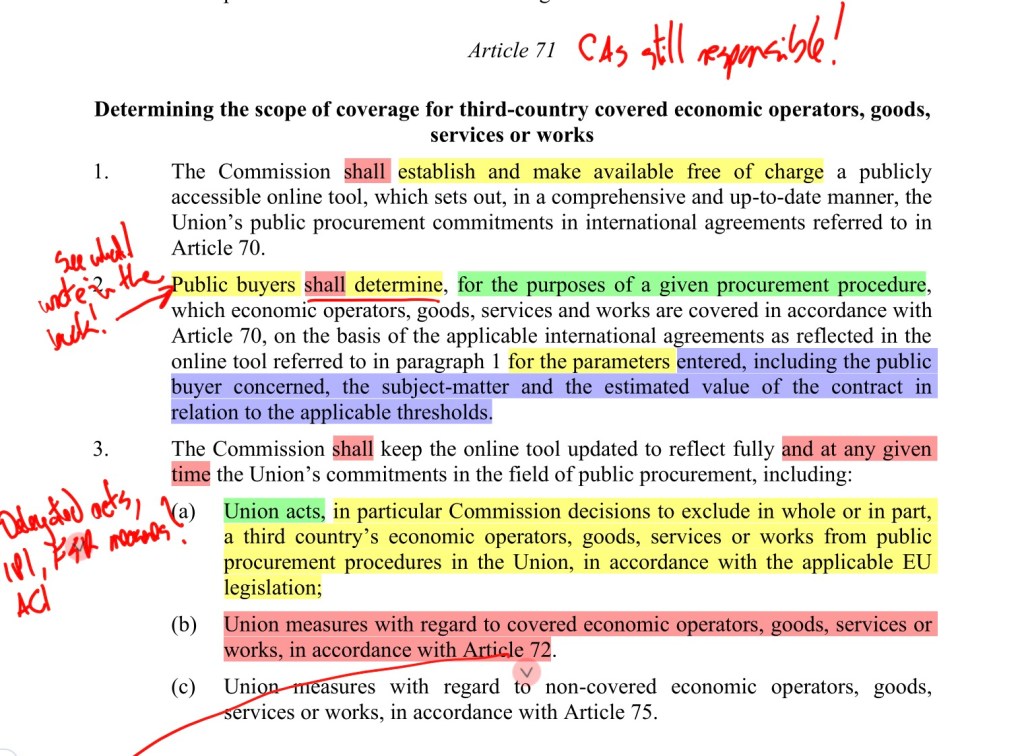
(See Pedro’s thoughts here)
In the last week’s commentary on Article 70, I mentioned the inherent complexity in determining what will be covered economic operators, goods, services and works from one public procurement procedure to the next. A ‘covered’ economic operator in one procedure may not be ‘covered’ in another conducted by the same contracting authority. The aim of Article 71 is to make this aspect of procurement easier for contracting authorities, and it is a significant improvement on the Commission’s earlier stance.
The Commission’s (controversial and widely criticized) 2025 non-paper on the ‘Participation in the EU procurement market of bidders from non-covered third countries’ answered questions on establishing the origin of economic operators – but shifted responsibility when using online tools towards contracting authorities:
Notwithstanding the practical added value of the Commission tools listed below, it is the sole responsibility of the contracting authorities / entities in the EU to assess whether the bidder is established in a country that has or, does not have, an international agreement with a chapter on public procurement. For that purpose, they can use the dedicated online tool – Procurement4Buyers – to check whether a given tender is, or is not, covered by EU’s international commitments:
https://webgate.ec.europa.eu/procurementbuyers/#/procumementlocation
Here is a link to the WTO GPA website where the EU’s commitments under the
GPA can be found:
https://www.wto.org/english/tratop_e/gproc_e/gp_app_agree_e.htm
For an overview of all international agreements in which the Union may have procurement commitments, please visit:
This position made the available online tools of very limited use as contracting authorities could not rely on their accuracy – as any potential error in established coverages would be something the contracting authority itself would answer for.
This time around – a welcome change. ‘Shall’ is used a lot, not a single ‘may’ in sight. The Commission takes responsibility for establishing a publicly available online tool (the Access2Markets web portal developed by the European Commission to assist businesses with international trade, according to the PPA proposal’s explanatory memorandum) that will gather all of the EU’s international agreements, their scope and coverages. This includes the WTO GPA and all other free trade agreements (or better yet – agreements with reciprocal procurement market access provisions – it would be difficult to define a Stabilization and Association Agreement as only an FTA). This tool needs to be:
- free
- publicly accessible
- comprehensive and up-to-date.
Keeping the tool comprehensive and ‘up-to-date’ is probably the most difficult task with managing such an online tool, therefore it is great the Commission takes the obligation (‘the Commission shall’) to ensure the tool shows the Union’s commitments accurately ‘at any given time’. This means monitoring and including:
- Union acts (for example measures taken under the International Procurement Instrument or the Anti-Coercion Instrument)
- delegated acts adopted under Article 72 – delegated acts revoking ‘covered’ status from economic operators from ‘covered’ countries when this is justified by the factual lack of reciprocity, security-threatening dependencies or for the reasons of economic security interests(which will be the subject of our next posts)
- delegated acts adopted under Article 75 – delegated acts making ‘European preference’ mandatory but subject to Article 76 exceptions (which will be the subject of an upcoming post)
The contracting authority’s responsibility seems to start with data input into the online tool. This must be done for each individual procedure, and the contracting authority needs to input:
- info on what kind of contracting authority it is (is it a central, sub-central or other entity)
- procurement subject-matter
- procurement estimated value.
All these factors will decide on coverages for the procurement procedure in question. For example, EU WTO GPA coverage Annexes list which types of contracting authorities need to open their procedures to WTO GPA covered economic operators, above which thresholds and for what type of goods or services.
So, the division of responsibility is clearer – the Commission is responsible for managing and updating the online tool with all relevant info, while the contracting authorities are responsible for correct input of all relevant info for a single procurement procedure in the tool. Therefore, I believe it is safe to conclude that the Commission is responsible for errors in the online tool, while contracting authorities are responsible for the data they put in the said tool.
But – the subtext that lurks behind all ‘European preference’ articles is – remedies. With that in mind, let’s game a scenario based on where a mistake is made.
Let’s say a contracting authority decides to use ‘European preference’ and either exclude or handicap non-covered economic operators, goods, works or services. This means the Commission’s online tool needs to be used, and the contracting authority decides that US economic operators are not ‘covered’ in this procedure.
But a US company begs to differ and challenges its exclusion before a national public procurement appeal body – as it has access in this stage when challenging its non-covered designation, but it would not have access to standard national procurement remedies (those where the directives were transposed) if admitted in the procedure as a non-covered economic operator. This could go in a few different directions but let’s concentrate on these two:
- a final decision is reached that the contracting authority made a mistake – and the US economic operator is granted access to the procedure
- a final decision is reached that the contracting authority made NO mistake – the US economic operator claims in the procedure (among other appeal claims) that there is an error in the Commission’s online tool, but the appeal body finds it is not competent to evaluate its accuracy.
The second situation is much more interesting. If a national procurement review body and/or court upholds the contracting authority’s decision excluding the US economic operator but refuses to address the claimed mistakes in the online tool (a not so difficult to imagine scenario across jurisdictions) – this means that a final decision claims the US economic operator is not a ‘covered’ operator in this procedure. Thanks to Kolin and Qingdao (gifts that keep on giving) and the Commission’s decision to keep these judgements as ‘principles’ in the PPA proposal – the US economic operator is not protected by EU law here according to paragraph 66 of Kolin.
Therefore – is the US economic operator even entitled to bring a case against the Commission and the perceived error in its online tool?
The US company will claim that since the online tool contains a mistake – it IS a ‘covered’ economic operator and therefore protected by EU law. But this does not resolve the fact that the US economic operator was barred access to the public procurement procedure based on a final decision from a national procurement appeal body and/or court. Not sure how all of this applies to the Union’s/Commission’s non-contractual liability under Article 340 TFEU, would love to hear what you think.
To conclude – there was a lot of talk about the simplification of EU procurement rules. The Commission presented the PPA proposal as a big step in this direction, but there has been academic pushback on these claims. If the Article 71 online tool is to be indispensable to contracting authorities but the resolution of disputes that may originate from its use is not adequately addressed – it will contribute to complexity via litigation instead of simplification.
It also seems to me that one of the biggest contributions to the simplification of the ‘European preference’ chapter and third-country (non-covered) economic operator participation in EU public procurement procedures would be – ditching Kolin and Qingdao and reinstating full and equal remedies to all participating economic operators.


1 Comment Leave a comment ›