Public Procurement Act proposal commentary – Article 75 – Union restrictions for third-country non-covered economic operators, goods, services and works
(See Pedro’s thoughts on Article 75 here)
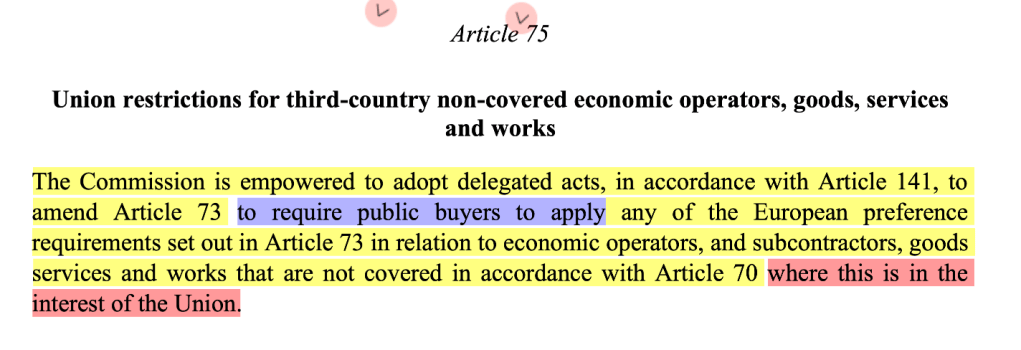
Like Article 72, Article 75 is the second ‘European preference’ Article empowering the Commission to adopt delegated acts. While Article 72 delegated acts are aimed at revoking covered status (in a legally problematic way), there is almost nothing legally problematic here. The Commission is empowered to ‘require public buyers to apply any of the European preference requirements set out in Article 73’. This authority encompasses both economic operators and subcontractors, goods, services and works ‘that are not covered by Article 70’.
A couple of things about the interaction of different potential Commission delegated acts – those under Articles 72 and 75. Both of those delegated acts are designed to intervene in Articles relevant to the rules they are circumventing: Article 72 gives the Commission the authority to revoke covered status by – amending Article 70. In the same way – Article 75 gives the Commission the authority to make ‘European preference’ mandatory for contracting authorities by – amending Article 73. Therefore, it will be important to be mindful of all the various delegated acts the Commission adopts here across both Articles 72 and 75, and have the right version of the consolidated text available. This is especially important as these delegated acts can also be revoked – making the potential list of EU Public Procurement Act amendments significant (of course, if the Commission decides to exercise the powers given by these Articles).
Not much to go on when trying to guess when the Commission will use Article 75. But the potential answer will revolve around three different things:
- the discretionary nature of the Article itself,
- the definition of the ‘interest of the Union’, and
- Article 141 of the PPA proposal.
The Commission is ‘empowered’ to adopt delegated acts under Article 75, meaning that they are not mandatory. This further means that even if the Commission finds the delegated act is ‘in the interest of the Union’ – it may decide not to adopt it. While this is not likely, the wording of the Article makes it possible. But this IS very likely if Parliament and/or the Council (Member States!) have a very different idea of what ‘the interest of the Union’ really is. This is where Article 141 becomes important.
Delegated acts under Article 75 (as well as Article 72) are to be ‘adopted in accordance with Article 141’. Article 141 gives Parliament and/or the Council the authority to ‘revoke at any time’ the Commission’s authority to adopt these delegated acts. Furthermore, the entry into force of these delegated acts is dependent on (at least tacit) agreement of both the Council and Parliament. If either institution objects – the delegated act will not enter into force. This would require a qualified majority vote in the Council – making it possible for a sceptical group of third-country-friendly Member States to table the delegated act. This way, via Article 141 – both of these institutions and a qualified majority of Member States may challenge the Commission’s interpretation of what really is in the best interests of the EU, and they can even supplant it with the best interests of a number of Member States.
This brings us to the vagueness of the ‘interest of the Union’ provision. This vagueness is somewhat mitigated by Recital 34:
The Commission should be empowered to close specific procurements to non-covered economic operators or non-covered goods, services or works on the condition that such closure is in the interest of the Union. The interest of the Union to close certain procurements should be assessed based on an appreciation of all relevant interests taken as a whole, in particular economic, geopolitical and societal interests of the Union, its Member States and its citizens. The relevance of such Union interest is illustrated by sectors such as railways and shipbuilding which, as manufacturing sectors of a dual-use nature, rely on infrastructure, mobile assets and information and communication technology (ICT) and traffic management systems that must be resilient and are critical to military mobility, security, and the Union’s strategic autonomy objectives. Their strategic importance has been underlined by recent Union initiatives including the EU Economic Security Strategy, the EU High-Speed Rail Plan, and the EU Maritime Industrial Strategy. The Joint Communication on strengthening EU economic security also emphasised the risks related to involvement of high-risk entities in sensitive sectors and supply chains.
While it is probably necessary to word it this way (Union interests are a shifting category that eludes legal definition/enumeration) – it is therefore manipulable and open to different interpretations by the Commission, Parliament, Council and Member States (via the Council).
That said, it is questionable how mandatory a possible delegated act under Article 75 can really make ‘European preference’ provisions, as Article 76 gives wide discretion to contracting authorities to use exceptions. But that is something to address in next week’s commentary on Article 76.


