Public Procurement Act proposal commentary – Article 76 – Exceptions
(See Pedro’s thoughts on Article 76 here)
Articles 73, 75 and 76 make a dysfunctional whole. Article 73 lays out the European preference requirements which are discretionary to public buyers. Then Article 75 gives the Commission the authority to make some (or possibly all) of those requirements – mandatory via delegated acts. But public buyers get the last laugh, as Article 76 allows them to ignore European preference requirements even if they were made mandatory via Commission’s delegated act or sectoral Union legislation, where Article 77 makes the ‘European preference’ chapter applicable.
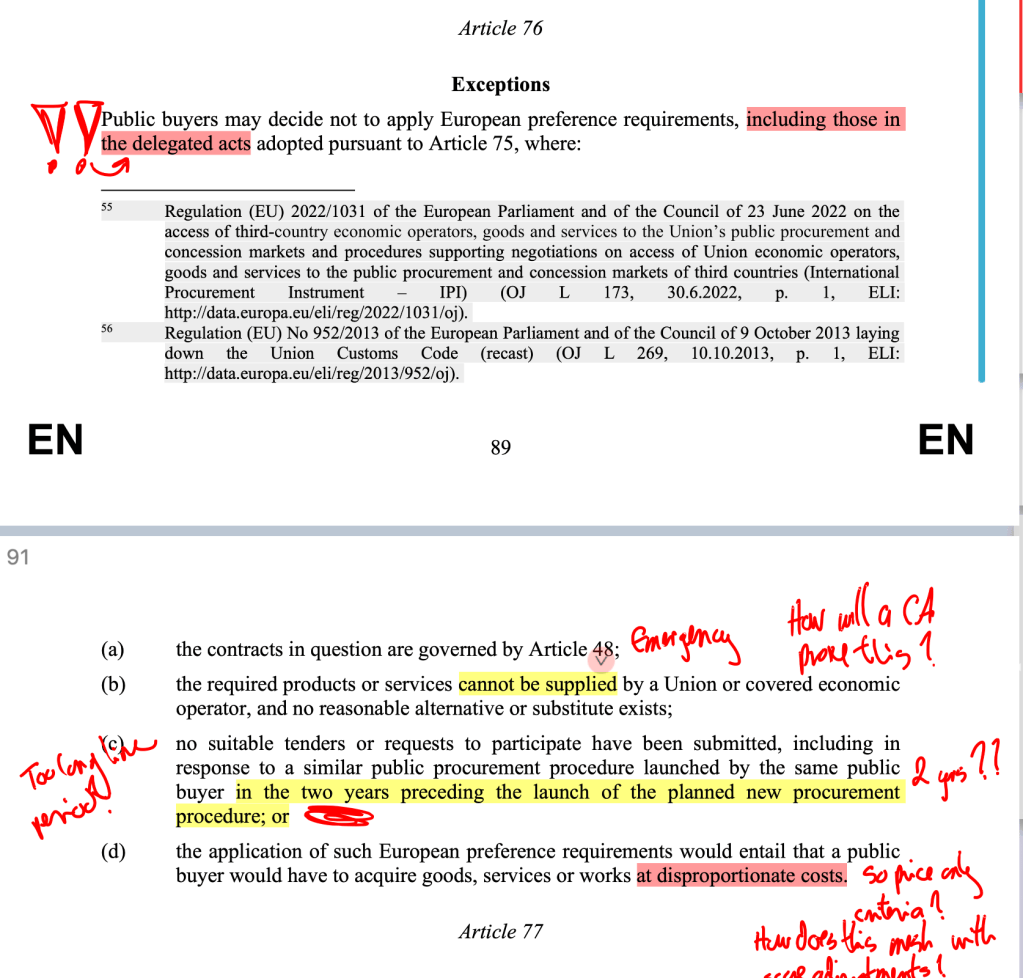
Article 76 recognises four situations where public buyers may deviate from mandatory ‘European preference’ requirements. The first one allows deviations when Articles 46 and 48 are applied – these are situations when public buyers may use a special procedure (by requesting a solution directly from one or more economic operators without the need for a competitive process or prior publication of information on the tender) due to ‘reasons of extreme urgency not attributable to the public buyer’. This is especially applicable if the Commission declared ‘a crisis or a state of emergency’. While this exception makes sense from a public interest standpoint and is (at least in part and sometimes) constrained by the Commission’s decision to declare a state of emergency – the other three exceptions give public buyers plenty of discretionary power not to apply mandatory European preference requirements in many of their public procurement procedures.
If a public buyer is procuring goods or services – it may ignore mandatory European preference requirements if they cannot be supplied by ‘a Union or covered economic operator’ and if ‘no reasonable alternative or substitute exists’. Three separate issues unfold here. The first is – this decision depends heavily on the public buyer’s level of market research prior to the procedure itself, and there seem to be no specific requirements demanding any level of detail from the public buyer. Therefore, a public buyer wishing not to apply European preference requirements may just – do a poor market analysis. Although Article 109 requires public buyers to document and justify their decisions, market consultations are also – discretionary under Article 30 of the PPA proposal! Second – as Article 73 has shown – European preference can be applied to non-covered economic operators on the one hand, and non-covered goods and services on the other -separately. So there is a chance of covered economic operators making arrangements to tender non-covered goods or services – making this exception possibly less potent and not clear enough for public buyers wishing to apply it. Third – there are no guidelines how to ascertain in the most objective way what would be a ‘reasonable alternative or substitute’. While a valid response to this would be that this should be left to appeal bodies and courts to decide, and that public buyers may draw on the interpretation of Article 32 of Directive 2014/24/EU (Use of negotiated procedure without prior publication) as it contains the same phrase – at least initially we could expect various approaches to the interpretation of this provision by public buyers.
Point (c) allows public buyers not to apply mandatory European preference requirements if ‘no suitable tenders or requests to participate have been submitted, including in response to a similar public procurement procedure launched by the same public buyer in the two years preceding the launch of the planned new procurement procedure’. Here we have a lot to unpack.
‘If no suitable tenders or requests to participate have been submitted’ considers all procedures – not only those where a public buyer decided to implement European preference requirements.
‘Including in response to a similar public procurement procedure launched by the same public buyer’, read together with the first part of point (c) may suggest that public buyers do not have to be guided only by their own public procurement procedures when deciding to apply this exception – they may even be guided by failed procurement procedures conducted by other public buyers! This is somewhat similar to Article 101(1)(c) of the PPA proposal (Abnormally low tenders), which allows public buyers to demand a tenderer to explain its low price if (inter alia) it is abnormally below ‘contract values in past procurement procedures with mostly identical subject-matter and conditions, in particular in past estimations, tenders or prices paid by the same public buyer or other public buyers’. Article 101(1)(c) is much clearer as it plainly includes ‘other public buyers’, which Article 76(1)(c)does not. So, if this was not the intention of the Commission in drafting this provision – it might need a rewrite. It is possible that the intention of the provision was to allow public buyers to disregard mandatory European preference measures if no suitable tenders were submitted in a previous procedure – no matter what the object of the procurement was. But if my original interpretation is correct, it creates a new set of very difficult questions: how will public buyers keep track of all those similar procedures conducted by other public buyers; are they limited only by national examples or must they consider examples from other Member States? But also, and not connected to the question of which public buyer’s previous public procurement procedures are relevant, how will the ‘similarity’ of the failed procedure and the planned one be evaluated? One example – a public buyer gets no suitable tenders for 10 electric buses when requiring 90-day delivery. Two years later it conducts a new procedure for the same 10 buses but with a 12-month delivery – and treats it as ‘similar’. But the lack of tenders in the first procedure might be the result of a short delivery deadline, not of a shortage of suppliers.
‘In the two years preceding the launch of the planned new procurement procedure’ – two years is a very long time, in which market conditions may change completely. New entrants may arrive; new products or services may become available – making this provision a tool that permits participation by non-covered operators or the supply of non-covered goods or services even if alternative covered ones have arisen in the meantime. This must also be read in conjunction with Article 30 of the PPA proposal – which makes conducting market consultations discretionary. This further allows public buyers to rely on the lack of competition in a procedure conducted two years ago without even checking the level of competition now, immediately before launching a new procedure. Article 109 (public buyers must document and justify their decisions) seems like an ineffective broad obligation here.
But the biggest loophole allowing public buyers to disregard mandatory European preference provisions is the one from point (d) – if ‘the application of such European preference requirements would entail that a public buyer would have to acquire goods, services or works at disproportionate costs.’ This has to be read in conjunction with this paragraph from the PPA proposal’s explanatory memorandum:
The European preference provisions in sector-specific acts are necessary to respond to the new geopolitical imperatives, while fully respecting the Union’s international commitments. They are designed in a proportionate manner so as not to impose disproportionate financial burdens on contracting authorities’ budgets.
The problem is – neither Article 76 nor the explanatory memorandum gives a definition or range of what could be considered ‘disproportionate’, allowing public buyers to approach this creatively and ignore the Commission’s mandatory European preference delegated acts practically every time they procure. Also – what are ‘costs’? The purchase price alone, or life-cycle costs, including costs imputed to environmental and climate externalities under Article 99? How should ‘disproportionate costs’ be assessed consistently with Article 98’s emphasis on the ‘best price-quality ratio’? This gets us back to the question posed many times in our commentary on previous articles of the ‘European preference’ chapter – how effective can all this really be? Sectoral legislation may establish stricter requirements or different exceptions, which Article 77 allows to prevail. That relationship deserves separate consideration next week.
One more interesting comparison – Article 9 of the International Procurement Instrument also allows public buyers to ‘decide not to apply an IPI measure’ in a procedure where only non-covered economic operators from a country subject to an IPI measure have submitted tenders or the decision not to apply the IPI measure is justified by overriding public interest reasons. But if a public buyer decides to do so, paragraph 2 applies:
2. Where a contracting authority or contracting entity decides not to apply an IPI measure, it shall provide the following information to the Commission, in a manner to be decided by the respective Member State and no later than thirty days after the award of the contract:
(a) the name and contact details of the contracting authority or contracting entity;
(b) a description of the object of the contract;
(c) information on the origin of the economic operators;
(d) the ground on which the decision not to apply the IPI measure is based, and a detailed justification for the application of the exception;
(e) where appropriate, any other information deemed useful by the contracting authority or contracting entity.
The Commission may ask the Member States concerned for additional information.
No such obligation under Article 76 of the PPA proposal (Article 109 of the PPA proposal and its documentation transparency requirements do not create such a specific obligation). Maybe there should be?


